

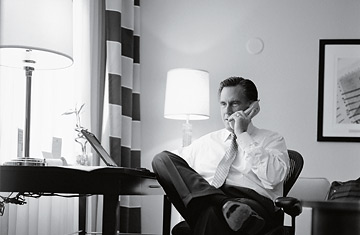
Presidential hopeful Mitt Romney in his hotel in Miami, March 9, 2007
Mitt Romney's presidential campaign had asked for some old family photos, which is why, not long ago, the candidate happened to be going through mementos he had dumped on his dining-room table. In one of the boxes, he came across a letter he recognized well: typewritten, single-spaced, six pages long. He has read it so many times that he can recite parts of it by heart. Romney first opened it four decades ago, when he was in France doing Mormon missionary work. The letter was from the father he had idolized growing up, and still does, the man he has described as "the definition of a successful human." This, however, was an epistle about failure--about the one time his father had attempted something big and fallen short.
There was so much to tell the son who had been spared by distance from having to witness the father's humiliation, but the most important thing George Romney wanted Mitt to know was that he had no regrets. "Your mother and I are not personally distressed. As a matter of fact, we are relieved," he wrote on the last page. "We went into this not because we aspired to the office, but simply because we felt that under the circumstances we would not feel right if we did not offer our service. As I have said on many occasions, I aspired, and though I achieved not, I am satisfied."
If you are under 60, you probably don't have much of an idea who George Romney was. But early on in the wrenching election of 1968, the dynamic and visionary Michigan Governor was leading the field for the Republican presidential nomination. Most accounts at the time and since would blame his stumble on a rash, candid admission to a local television interviewer that his initial support of the Vietnam War was the result of "brainwashing" by the generals and the diplomats. But it has also become clear that there were larger forces at work against him. George Romney was a member of the party's liberal wing; he had withheld his support from Barry Goldwater in 1964 over civil rights. But by 1968 that strain of progressive Republicanism was starting to wither. Richard Nixon's triumph would be called a realignment, a no- looking-back turn to the right for the Republicans.
Now Mitt is the Romney who wants to be President--and once again it comes at a moment that has the potential to redefine the Republican Party. He has surprised the party's top contenders by raising more than $21 million, easily outpacing John McCain's anemic $13 million and Rudy Giuliani's $16 million. He's leading the other Republicans in one New Hampshire poll. And in the recent Republican debate, when the 2008 field was first lined up onstage, he was widely proclaimed the winner because of his presidential bearing. The shell-shocked G.O.P. is looking away from Washington for a fresh face, a miracle-worker résumé and a big dollop of charisma. Could Mitt Romney be The One?
A FATHER'S LESSON
THE MORNING AFTER HE FOUND THAT LETTER again, Romney was headed to Iowa for the 16th time in the past two years. "The older I get, the smarter Dad is," Romney said. "I pattern myself like him--his character, his sense of vision, his sense of purpose."
But if there's anything the psychodrama of the two Bush presidencies should have taught us, it is that what fathers bequeath their sons is complicated. When you look at the old pictures of George Romney, it is impossible to miss the physical resemblance--the chiseled jaw, the bountiful hair, the athlete's bearing. At every turn, Mitt Romney has steered his life into his father's groove, becoming a leader in the Mormon Church, a business whiz, a Republican Governor who defied his party's orthodoxy and won in a Democratic state. Each engineered the spectacular rescue of a failing enterprise: the elder Romney, a car company; the younger one, the 2002 Winter Olympics. And now, at 60, Mitt is the age his father was when he ran for President, almost to the month. Romney sees it too, as he told George Stephanopoulos on ABC, "My dad, I mean, I am a small shadow of the real deal."
Whether Romney 2.0 is a real deal is precisely what everyone wants to know these days. Beyond the appearance and the résumé lies perhaps an important difference from the earlier Romney. Whereas George stood firm and true against the prevailing political winds, Mitt seems as if he can dress himself as a politician for any season. You can't help wondering whether what he learned from his father's steadfastness was an object lesson in what not to do if he doesn't want to end up as a footnote in someone else's presidential memoirs.
Running in liberal Massachusetts, Mitt Romney insisted that, despite his personal pro-life beliefs, "abortion should be safe and legal in this country ... I sustain and support that law, and the right of a woman to make that choice." Currently playing on YouTube is an artfully edited video of a debate from his 1994 Senate campaign (an instance in which Romney made a career move his father hadn't, and lost to Ted Kennedy). In it, Romney declares of his pro-choice abortion stand, "You will not see me wavering on that or be a multiple choice." He cites his mother, who ran unsuccessfully for the Senate from Michigan in 1970 as an abortion-rights advocate, and the searing tragedy of his brother-in-law's teenage sister--"a dear, close family relative who was very close to me"--who died of a botched illegal abortion in the 1960s.
Those close to Romney doubt he was ever as committedly pro-choice as those comments might have made him seem. More likely, this school of thought argues, Romney figured abortion restrictions were not apt to come to the Governor's desk in a state as liberal as Massachusetts. Says longtime friend Joel Peterson, founder of a Salt Lake City equity firm: "He knew that they would never come up for a vote, so he took it off the table. Does that sound politically expedient? Maybe."
Now that he is in a presidential-primary battle in which Evangelicals account for a quarter of the electorate, however, Romney says the landmark Supreme Court decision on abortion, Roe v. Wade, has "cheapened the value of human life." And that's not the only place where he seems to have retrofitted his views to the tastes of the voters he is trying to win. Whereas Romney dedicated himself in Massachusetts to "full equality for America's gay and lesbian citizens," he now describes himself as "a champion of traditional marriage." As a candidate for Governor in a state known as Taxachusetts, Romney dismissed the idea of an antitax pledge as a gimmick and refused to sign it; as a G.O.P. presidential contender, he was the first in the 2008 field to put his name on one.