

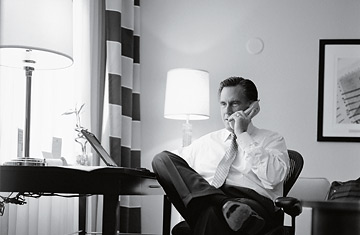
Presidential hopeful Mitt Romney in his hotel in Miami, March 9, 2007
(2 of 4)
In Massachusetts he bucked the National Rifle Association by supporting the Brady Bill and an assault-weapons ban, boasting, "I don't line up with the N.R.A." Lately what he brags about is that he joined the gun-rights organization as a life member--last August. Romney has been so eager to prove his Second Amendment bona fides that he boasted in New Hampshire, "I've been a hunter pretty much all my life." But then his campaign admitted he had actually hunted only twice, once as a teenager and then last year, on a trip with G.O.P. donors. That was followed by still more clarification: Romney insisted he has hunted small animals for many years, though he does not actually own a firearm. "Leave it to Mitt Romney to shoot himself in the foot with a gun he doesn't own," wrote Boston Globe columnist Joan Vennochi.
FLEXIBILITY VS. EXPEDIENCY
AS YOU COMPARE WHAT HE STOOD FOR IN Massachusetts with what he says now, it seems fair to ask, Was Mitt Romney telling us the truth about himself then, or is he telling it now? What is flexibility, and what is expediency? Romney insists that everything he has said has come from his heart. On some issues, he argues, the landscape changed, not he. When he spoke out in 1994 in favor of civil rights for gays--a position he says he still holds--gay marriage was not even on the political or judicial radar screen. In other instances, he says, his opponents are finding contradictions where they don't exist. While his views don't in fact line up with the N.R.A.'S on every issue, he says, he has always supported the basic right to bear arms. "You can make the same statement, and if someone's going to write a story, they'll cover one part of the sentence instead of the other, and they'll say, 'Oh, it's different now,'" he tells me, but adds with his typical unflappability, "That's the nature of politics. I don't particularly mind that."
On abortion, Romney says he simply changed his mind. He recalls that it happened in a single revelatory moment, during a Nov. 9, 2004, meeting with an embryonic-stem-cell researcher who said he didn't believe therapeutic cloning presented a moral issue because the embryos were destroyed at 14 days. "It hit me very hard that we had so cheapened the value of human life in a Roe v. Wade environment that it was important to stand for the dignity of human life," Romney says. "We learn with experience. We gain perspective over time, but the principles remain the same. I have a number of principles, and the principles remain the same."
Can Romney convince voters there is indeed a core somewhere in the middle of all those contortions? That challenge could determine whether he's in the race for the long haul or just an early, forgettable flash. Of the many reasons the last presidential candidate from Massachusetts lost, nothing was so devastating as the 13 words John Kerry would give anything to take back: "I actually did vote for the $87 billion before I voted against it." But given that we've had three years since then to reckon with the consequences of inflexibility on Iraq, maybe there isn't the same price to be paid for reinvention.
It remains to be seen, though, how Romney's transformation will wash with conservative voters. "He does not appear to be credible in his deathbed conversions--pro-life, anti-homosexual agenda and so on," says Paul Weyrich, a founder of the Heritage Foundation and the Moral Majority--intellectual and religious bulwarks of what was once known as the New Right. "People simply do not believe him."
Others do see a consistency, if not in where he has been then at least in the direction in which Romney is going. With McCain, there is an ideological drift that makes him harder to peg or predict, as he sides with conservatives on issues like abortion and against them on the question of a constitutional amendment to ban gay marriage and on filibustering judicial nominees. "To me, [Romney's evolution] shows that he's at least willing to listen and change. I see it as sincere," says former South Carolina Congressman Tommy Hartnett, a Catholic who has endorsed Romney in that early-primary state.
THE VENTURE CAPITALIST
ROMNEY'S TRAINING FOR THIS RACE STARTED early. He was 15 when his father ran for Governor in a state in which no Republican had held the job in 14 years. Mitt worked the campaign switchboard and traveled the county-fair circuit in a Ford microvan. George put Mitt to work at the "Romney for Governor" booths, shouting over a microphone and loudspeaker system, "You should vote for my father for Governor. He's a truly great person. You've got to support him. He's going to make things better." Mitt realizes now that his dad had something in mind beyond his own political career: "He was teaching me how to get out there."
Willard Mitt--who was called Billy until he was old enough to protest that he liked his middle name better--was the baby of the family, whose arrival six years after his three siblings' is remembered as a shock and a miracle. When Mitt was 7, George took over a failing car company called American Motors and introduced a radical design concept in the era of soaring tail fins and acres of chrome: something he called the "compact car," a sedan built on a smaller frame to be cheaper.
The Rambler turned out to be a hit, in no small part because George Romney turned it into a crusade as well as a business. He made the cover of TIME in a 1959 story that described him as "a broad-shouldered, Bible-quoting broth of a man who burns brightly with the fire of missionary zeal." TIME noted that George Romney was a particular hit at women's clubs, where he would fix them with "his blue-grey eyes" and say, "Ladies, why do you drive such big cars? You don't need a monster to go to the drugstore for a package of hairpins. Think of the gas bills!" Turning those sales techniques to politics wasn't much of a stretch.
One thing he was willing to stretch, or at least test, was the U.S. Constitution. It is debatable whether George, having been born to U.S. expatriates in Mexico, fit the Article II requirement that a President be a "natural born Citizen." His son was asked at the first Republican debate whether that requirement should be changed to allow, say, Austrian-born California Governor Arnold Schwarzenegger to run. "Probably not," Mitt answered.