

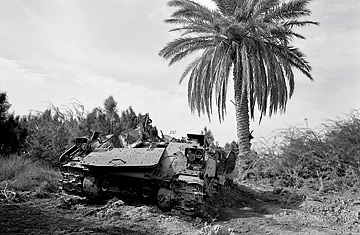
An American Bradley (APV) that was hit by an IED in Ramadi.
(4 of 5)
The army has also skimped on armor. "You go to war with the Army you have," Rumsfeld famously told a grunt who complained of inadequate armor in 2004, "not the Army you might want." Lieut. General Stephen Speakes, the Army's top planner, recently recalled the shock Army leaders felt when Private Jessica Lynch and the 507th Maintenance Company stumbled into an ambush in Nasiriyah that left 11 of her comrades dead in the war's opening days. "We found to our horror that this was a logistics unit that had no ... [major] weapons, no night vision, none of the modern enablers for war," he said. "And we said, Well, they were never supposed to fight." The Pentagon war plan called for a neat conflict with well-defined front lines that support troops like Lynch could be safely stationed behind.
But in a guerrilla war, even those soldiers are on the front lines, and protecting them isn't cheap. A World War II G.I. wore gear worth $175, in today's dollars. By Vietnam, it cost about $1,500. Today it's about $17,000. Amazingly, the Army had only 32,000 sets of body armor when the Iraq war began. The Army now insists that troops don't go "outside the wire"--leave their heavily defended posts in Iraq--without adequate protection. But that's not what the Pentagon's inspector general reports. Some troops "experienced shortages of force-protection equipment such as up-armored vehicles, electronic countermeasure devices ... weapons and communications equipment," an unclassified summary of a still secret Jan. 25 report says. "As a result, service members were not always equipped to effectively complete their missions." Schoomaker, who declined an interview request, dismissed the inspector general's report at a February congressional hearing as "anecdotal in nature."
But even if they are simply anecdotes, they are not the only signs of a crisis in gear. Beyond the lack of weapons for stateside troops, Army stockpiles of equipment around the globe are shrinking as their contents are siphoned to Iraq, reducing the nation's ability to respond to the next crisis. And what is in Iraq is often not what is needed. The military badly miscalculated what the war would look like. It had plenty of monstrous M-1 tanks and thin-skinned humvees but not much in between. Yet 70-ton tanks don't win many friends in Baghdad streets, and the canvas doors of Army humvees offer scant protection against improvised explosive devices (IEDs). The Army said at the start of the war it would need 235 armored humvees; the number is 18,000 today--and each time the Army improves the armor on the truck, the insurgents improve their IEDs. The Army has packed on all the armor a humvee's transmission and axles can carry, so the military is rushing to buy 7,774 Mine Resistant Ambush Protected vehicles for an estimated $8.4 billion--more than $1 million each. Their V-shaped undercarriage is designed to deflect blasts from the soldiers on board.
HOW TO FIX IT
The army and the Pentagon bought into the notions that the war was going to be quick and easy and that victory would come right after the next Iraqi elections or the ones after that. As such optimistic scenarios proved false, the problem of shortfalls in troops and matériel got worse each year. A Republican-controlled Congress, wary of challenging a G.O.P. President on the war's course, added some funds but not nearly enough. Next year the Army is seeking a 19% budget hike, including a 55% rise in procurement dollars, to $130 billion.
The only way to fix the Army's woes is to effect a change in money or mind-set or probably some of each. The Army has been starved for cash since the cold war's end. (Its leaders gripe that from 1990 to 2005, their service pocketed just 16% of the Pentagon's hardware budget, while the Air Force got 36% and the Navy 33%.) Diverting funds from some of those two services' high-tech--and costly--cold war weapons could help restore the Army's health. And the Army needs to change its preferred way of fighting--also a vestige of the cold war--pitting tanks against tanks along well-defined front lines. "The Army still tilts toward dealing with conventional threats, " says Krepinevich, the retired Army officer. "I keep telling them, There's no tank army out there for you guys to fight."
If the Pentagon or, just as likely, Congress prefers not to cut politically popular weapon systems, it could simply ratchet up the defense budget. Many defense experts say about a 4% slice of the GDP (currently $13 trillion a year) should be viewed as the nation's "insurance premium" and be dedicated to the Pentagon. (It is at 3.8% now and dipped as low as 3% from 1999 to 2001.) The downside: as the nation's economy continues to expand, taxpayers run the risk of paying too much for their military. The upside: any agreed-upon slice of the national economy would permit smarter budgeting, since the Pentagon could count on predictable funding. Finally, the U.S. could retool its military ambitions. Emphasizing diplomacy over war, and alliances over unilateral actions, could lead to a reduced need for defense dollars.
"One of my favorite sayings is, Experience is the ability to recognize a mistake when you make it again," Gates told a congressional panel March 29. "Five times in the last 90 years, the United States has disarmed after a conflict--World War I, World War II, Korea, Vietnam and then the cold war." Gates noted that the U.S. spent 9.8% of GDP at the height of the Vietnam war, 11.7% during the Korean conflict and 4.4% in 1991, at the end of the cold war. But after enjoying peace dividends for several years following each war, the U.S. "discovered that the world hadn't really changed" and was forced to beef up military spending.
McCaffrey, the retired general, says the Joint Chiefs are responsible for the state of today's Army. They rubber-stamped Rumsfeld's plan to build a smaller, more agile force while fighting two wars. McCaffrey, a Vietnam veteran, recalls the scolding lesson of Dereliction of Duty. That 1997 book explained how the Vietnam-era Joint Chiefs' timidity in challenging Defense Secretary Robert McNamara allowed the U.S. to slide into that war. Written by H.R. McMaster, an Army colonel now in Iraq, the book has been required reading for many military officers. "Should there be a Dereliction of Duty II?" McCaffrey wonders aloud. "The answer is, Yes, of course."