

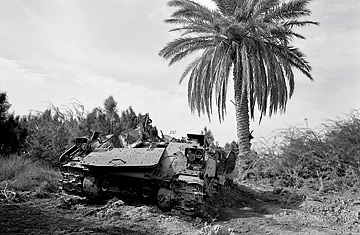
An American Bradley (APV) that was hit by an IED in Ramadi.
(3 of 5)
For its part, the Bush administration boasts of its plan to permanently boost the Army by 65,000 troops, to 547,000, over the next five years. Gordon Sullivan, a retired Army chief of staff and head of the Association of the U.S. Army, says the service's size "should be approaching 700,000" to do the job the nation expects of it. But where will such numbers come from?
True, the Army is making its recruiting targets--but only by accepting less qualified people. Recruits from the least-skilled category have climbed eightfold, to nearly 4%, over the past two years. Just 81% had high school diplomas last year, a sharp drop from 94% in 2003. The past two years have been the first in a decade in which the Army missed the Pentagon goal of 90% with diplomas. (The rest have GEDs.) The Army has boosted the maximum enlistment age from 35 to 42--but 12% of recruits over 35 drop out within six months, double the rate for younger soldiers. To boost its numbers, the Army has had to cut its standards. It granted recruits nearly twice as many waivers for felonies and other personal shortcomings in 2006 as it did in 2003. Such waivers allow prospects with criminal records, medical problems or poor aptitude scores to enlist. They climbed from 4,918 in 2003 to 8,129 last year, Pentagon data show.
One response to difficulties in recruitment: stop people from leaving. Sergeant Isaiah Santopoalo is one of 70,000 soldiers who have been barred from quitting the Army by a stop-loss order that keeps G.I.s in uniform beyond their retirement date or the end of their enlistment obligation. Since 2004, the Army has denied departures for troops headed to or already in Iraq or Afghanistan as a way to promote continuity in fighting units. "I definitely want to get out," says Santopoalo, 22, of the 73rd Cavalry Regiment outside Baqubah, 30 miles east of Baghdad. Three weeks before his enlistment was up last year, the Army ordered him to Iraq for a second tour. He had been planning to live with his wife in Chicago and attend film school by now. Instead, Santopoalo stalks Sunni insurgents through the palm groves. "You start to think about what life could be--sitting on a beach drinking a Corona," he says. "That's when it affects you."
The Army has been turning to its sister services for enlistees. About 20,000 "sandbox sailors" from the Navy and airmen from the Air Force are serving as "in lieu of" soldiers--driving trucks and providing security in Iraq and Afghanistan. Dedicating Air Force personnel to Army missions is hurting the Air Force, its leaders have told Congress. "The Air Force doesn't guard prisoners. We don't have prisoners," Air Force Secretary Michael Wynne told Congress Feb. 28. "The Army guards prisoners." But the Air Force is guarding them now in Iraq because the Army doesn't have enough troops. The Army is even cannibalizing the other services' officer corps, recruiting 325 so far (in exchange for a $2,500 bonus), with 200 more expected to switch to Army green this year, now that the bonus has been raised to $10,000.
DOLING 0UT CASH AND PROMOTIONS
To keep soldiers in uniform, the Army is spending money like, well, a drunken sailor. It will pay out close to $1 billion this year and next to attract and keep them in the force. The Army is weighing special dwell-time bonuses for soldiers who spend less than two years at home between deployments. It's considering boosting, after one combat tour, the $225 monthly bonus soldiers get for serving in a war zone.
All these incentive campaigns are getting expensive. The service paid more than $600 million in retention bonuses in 2006, up from $180 million in 2003. (If that seems excessive, the Army notes in an internal document, "New York Yankees payroll: About $350 million," although it's actually closer to $190 million.) Nearly all soldiers deployed to Iraq, Afghanistan or Kuwait receive up to $15,000 for re-enlisting. Soldiers and retirees pocket a $2,000 bounty for identifying a prospective recruit who enlists. (Immediate family is exempt.) On March 15, the service extended the bonus offer to its 240,000 civilians.
There's more money to come. The Army is weighing a program that would offer soldiers a choice between a down payment for a new home or money to launch a small business--up to $45,000. "Home-buying assistance is being offered by other employers (e.g., Princeton)," the Army argues in an internal document detailing the proposal, although the Ivy League school isn't quite so generous. The Army expects the program "to be a major recruiting-market attraction--the next Army College Fund," says Lieut. General Michael Rochelle, the Army's top personnel officer.
Attracting and recruiting good men and women is a problem that goes up through the ranks. The Army will be at least 3,000 midlevel officers short through 2013 because of overly deep cuts made in the young officers' ranks a decade ago. It has only 83% of the majors it needs, for example, and has what it calls "critical shortfalls" in specialties such as aviation, intelligence, engineering and military police. To fill the gaps, the Army is promoting green officers more quickly. Captains are advancing to major after 10 years instead of 11; lieutenants can be pinned on as captains after 38 months instead of the usual 42. But the Government Accountability Office (GAO) recently warned that such fast promotion hurts officers' ability "to master their duties and responsibilities."
The war in Iraq hurts in other ways too. As the public increasingly turns against the war, what the Army calls its influencers--parents and teachers--are steering children away from military service. "Negative attitudes toward Army ROTC are increasing on college campuses because of opposition to operations in Iraq," the GAO said in a January report. Those attitudes--and budget cuts--meant there were only 25,100 ROTC cadets last year, 6,000 shy of the target. The U.S. Military Academy generated 846 freshly minted 2nd lieutenants in 2006, 54 short of its goal. West Point officials told the GAO that the reduction "may be the result of ongoing operations in Iraq." The war's toll can be seen in how many Army officers stay beyond their five-year required minimum term of service. Just 62% of West Pointers re-upped, about 25 percentage points lower than at the other service academies.
A SHORTAGE OF GEAR