

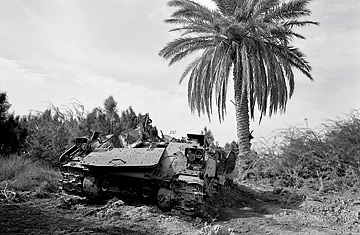
An American Bradley (APV) that was hit by an IED in Ramadi.
(2 of 5)
Today half the Army's 43 combat brigades are deployed overseas, with the remainder recovering from their latest deployment or preparing for the next one. For the first time in decades, the Army's "ready brigade"--a unit of the famed 82nd Airborne Division primed to parachute into a hot spot anywhere in the world within 72 hours--is a luxury the U.S. Army cannot afford. All its forces are already dedicated to the wars in Iraq and Afghanistan. Repeated combat tours have "a huge impact on families," General Peter Schoomaker, the Army chief of staff, told Congress in February. Those deployed to Iraq or Afghanistan more than once--170,000 so far--have a 50% increase in acute combat stress over those who have been deployed only once. And that stress is what contributes to post-traumatic stress disorder, according to an Army study. "Their wives are saying, I know you're proud of what you're doing, but we've got to get out of here," says Barry McCaffrey, a retired four-star general.
New Defense Secretary Robert Gates concedes there are readiness problems. He told Congress March 29 that next year's proposed $625 billion defense budget--the highest, adjusted for inflation, since World War II--will "make a good start at addressing the readiness" issues plaguing the Army. His first concern before taking the post in December was his suspicion "that our ground forces weren't large enough," and he has urged troop hikes starting next year.
THE WRONG KIND OF WAR
The army's problems were long in the making, and the extended deployments in Iraq and Afghanistan have exposed them for all to see: more than a decade of underfunding for boots on the ground while cold war administrations from Richard Nixon's to Bill Clinton's spent lavishly on the Pentagon's high-tech wizardry. The first Gulf War didn't help. It lasted 100 hours on the ground, was fought mainly from the air and reinforced the impression that grunts matter less than geeks.
Today's Army was molded for peacetime missions, with occasional spasms of all-out war, not for the lengthy guerrilla campaigns it is waging. "Following Vietnam, a lot of thoughtful officers said, This is not the kind of war that we want to fight," explains Senator Jack Reed, Democrat of Rhode Island, a Vietnam-era Army officer. Counterinsurgency wars didn't play to the U.S.'s strong suit--superior technology--and instead demanded patience, which is harder to come by in this culture. Even now, more than four years after invading Iraq, the Pentagon seems to be investing much of its current $606 billion budget in an effort to fight the wrong war. America's potential enemies around the world watched the first Gulf War and learned that the U.S. was unbeatable on a conventional battlefield. But the Defense Department lingered in a cold war hangover. The Air Force continues to buy $330 million fighters, and the Navy $2 billion submarines. (The Army is not free of this tendency. It wants to spend $160 billion on the Future Combat System, a network of 14 ground vehicles and drones of questionable value in the irregular warfare that's likely in the 21st century.) Gates has second-guessed the Pentagon's spending priorities and says he is studying whether the Defense Department is buying weapons "more tied to cold war needs than future needs." Even John Abizaid, the outgoing Army general who commanded the troops fighting in Afghanistan and Iraq for the past three years, acknowledges that he never had the right tools for his mission. "This is not an Army that was built to sustain a long war," he told a Harvard audience last fall. The force was so stretched, he warned Congress at the time, that a 20,000-strong troop surge in Iraq could not be sustained. Now that Abizaid is no longer in command, Bush has ordered 30,000 more troops into the fight.
Those in charge deny there's a crisis. Schoomaker, the Army's top general, served in the Vietnam-era Army. "I know what an Army that's near broken smells like, what it looks like, how it acts," he said in January. "Drug problems, race problems, insubordination--all kinds of things going on. We're nowhere near anything like that." General George Casey, who will succeed Schoomaker as the Army's top officer April 10, said at his confirmation hearing that "the Army is far from broken." The top brass acknowledge that they have had to husband their resources, pushing soldiers and supplies into combat and shortchanging everything else left behind. But a detailed look at the Army's people and its gear shows that the institution is barely holding together.
THE TROOPS ARE TIRED
Nearly 5,000 soldiers and their supporters met recently in Fort Lauderdale, Fla., at a gathering of the Association of the U.S. Army, a pro-Army group. A retired general spoke privately of a disconcerting change in recent months in the wounded soldiers he visits at Walter Reed Army Medical Center. "Ever since the war started, they'd be saying all they wanted to do was to get back to their buddies in Iraq to keep on fighting," he said. "Now it's more about getting out and wondering about civilian jobs. There's very little chatter about rejoining the unit."
That kind of frontline report unnerves the Army's high command. While they acknowledge that equipment shortfalls and faulty plans have plagued the Iraq campaign, they have always been able to parry such concerns by pointing to G.I.s--including those wounded in action--who believe in the war and are gung-ho to re-enlist.
The soldiers' change of heart is reflected in a poll by the independent Army Times. In December, for the first time, more troops surveyed disapproved of the President's handling of the war (42%) than approved of it (35%). Over the past two years, the number of troops surveyed who think victory is likely has fallen from 83% to 50%. Army suicides, an admittedly rough barometer of morale, show a steady increase, rising from 51 confirmed in 2001 to 91 (plus seven possible suicides still under investigation) last year. Desertions are climbing.
In the field, manpower shortages are everywhere. Captain David Eastburn's artillery company--part of the 2nd Infantry Division--arrived for its second tour in Iraq with only 72% of its personnel slots filled. "It just puts extra pressure on us," Eastburn, 30, says of his troops during a patrol in southeastern Baghdad. "They have to work longer, harder to make up for the lack of personnel." After training to fire the artillery's big guns at foes 15 miles away, his unit is pulling infantry duty. "I love the Army," the 12-year veteran, a native of Columbus, Ohio, says, "but I hate this war."
LOWERING THE STANDARDS