

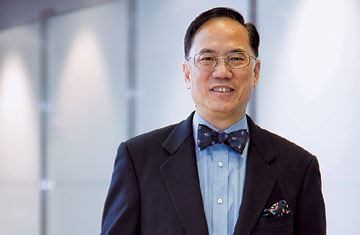
Donald Tsang, Hong Kong's Chief Executive
(3 of 3)
To be fair, the blame for a lack of sparkle in Tsang's administration so far cannot be laid solely at his door. Hong Kong's system is intended to have a strong Chief Executive, but the top official cannot be a member of a political party, which means that he has to build support from parties with often competing agendas, like the pro-business Liberal Party and the DAB, which champions Hong Kong's working class. Some believe that limiting the Chief Executive election to just an élite 800, who in turn are selected by only about 200,000 voters in various sectors and industries, robs Hong Kong's leader of the mandate that would come from being chosen in a direct, Hong Kong-wide ballot. "It's very much the structure of the system," says Larry Diamond, a senior fellow at Stanford's Hoover Institution who is a student of Hong Kong. "This is what happens when you're stuck halfway."
Tsang's boosters say that the best is yet to come, and point to his great strength: he's popular. With approval ratings consistently in the mid-60s, Tsang does not lack for support. "He's pretty good," says Johnny Lau, 35, an advertising worker taking a cigarette break beneath a campaign billboard for Alan Leong. In Mongkok, on the Kowloon side of Hong Kong harbor—and one of the most densely populated tracts of land on the planet—Rex Lau, 37, who is working in a bicycle-repair shop, echoes the sentiment. "Donald Tsang is doing okay," he allows. But then he adds a rider. "But he basically listens to what people in China want. It's like you have a say, but you don't really."
Born and bred in Hong Kong—his father was a policeman—Tsang rose through the ranks of the colonial civil service, a common career choice for Hong Kongers with plenty of brains but little money. A devout Catholic (like a surprising number of key people in Hong Kong), Tsang has his roots deep in the city. Because of his background as an official in the British administration, for which he received a knighthood, Hong Kong's leftist camp has never fully trusted Tsang as a Beijing loyalist. Indeed, the conventional wisdom is that China's leaders are still feeling him out. But among his own people, that doesn't necessarily hurt Tsang. "They see him as someone who is not a partisan of these groups," says Michael DeGolyer, who heads the Hong Kong Transition Project at Hong Kong Baptist University. "He basically identifies with [Hong Kongers] against these outside forces."
For the sake of both Hong Kong and Beijing, the future political arrangements of the city need to be settled soon. The Basic Law, Hong Kong's post-1997 constitution, which is based on a Chinese agreement with Britain on the colony's handover, allows that direct elections for the Chief Executive and the Legislative Council are Hong Kong's eventual goal. But the document does not specify a road map or timetable toward it. While China's leaders are committed to the Basic Law, they seem in no hurry to embrace direct elections. "They're anxious about moving too fast," says Anson Chan. "They're worried that there will be implications for stability; that Hong Kong will become a welfare state; that the wrong people will get elected." Most of Hong Kong's top business leaders have traditionally been lukewarm toward full democracy, too, fearing that it could lead to populist policies that would undermine both the economy and, perhaps, their influence.
But a growing number of Hong Kong people feel the time for full democracy is already long past, and that any attempt to delay it is demeaning. Earlier this month, a group of democrats led by Chan unveiled a compromise proposal that would gradually implement universal suffrage. It's hardly a radical blueprint, and it dovetails with Tsang's own target of achieving full democracy by 2012, when his new five-year term will end. The response out of Beijing to Chan's plan, however, was anything but welcoming. Chen Zuo'er, the deputy director of the Hong Kong and Macau Affairs Office, was at pains to stress that it was Beijing—and by implication, not local Hong Kongers—that took the lead on political reform during negotiations with the British prior to the handover. Present-day activists in Hong Kong, Chen said, were just "people who now pretend to be democratic heroes."
Tsang says he can bridge the gap between Hong Kong and Beijing: "Perhaps I'm the only person able to do this [democracy] deal," he told TIME. Though he has stumbled once already on political reform, Tsang remains nothing if not confident. His campaign slogan is i'll get the job done. No question, he'll get the job. But whether he gets it done will determine Hong Kong's future for years to come.