

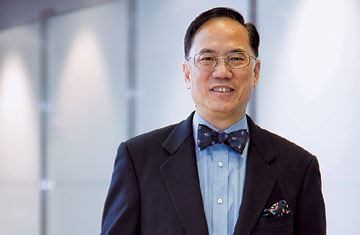
Donald Tsang, Hong Kong's Chief Executive
Tsang doesn't need any. The 62-year-old is running for a second term as Chief Executive—the strangely apt title for the head of Hong Kong's government. But the vote is restricted to the 800 members of an electoral college who are drawn from assorted business, professional and social groups. Most of them tend to bend whichever way the wind from Beijing is blowing. And, these days, it is blowing in Tsang's favor. Though he is facing a challenger from the city's democratic camp—lawyer and lawmaker Alan Leong—Tsang already commands 641 nominations from the Election Committee, and will defeat Leong handily in the ballot, which takes place on March 25.
But Tsang is acting as if he's in a real race. He has gone to the trouble of releasing a manifesto that spells out his ambitious plans to make Hong Kong a richer, cleaner, more equitable and more democratic society. In a town run by an aggregation of élites, he has pressed the flesh in working-class neighborhoods, engaged in televised candidate debates with Leong, and even taken a ride in an open-topped bus, waving to people who can't vote for him. Tsang is doing all this because he wants a wider mandate; he is a man with something to prove. "My objective," Tsang told TIME in an interview in his campaign office, "is not only to win the votes of the 800 people who are the delegates of the Election Committee. My campaign is to win the hearts of the 7 million people of Hong Kong."
The key point about Hong Kong's election is not about the contest, even though this is the first time an incumbent has been taken on. Nor is it about the result, which is not in doubt. What Hong Kong's people want to know is whether Tsang and his team can address the many challenges faced by one of the world's truly great cities. On the surface, Hong Kong is doing just fine, thank you. The economy is humming along—gdp growth was 6.8% in 2006 and is forecast to be at least a respectable 4.5% this year, not bad at all for a mature, first-world city. The stock market has dipped in recent weeks because of the global slump in equities, but is still up about 20% against a year ago. Real estate—a key and much-watched variable in Hong Kong—is robust again, and retail sales rose 7.3% in 2006 from the previous year's figure. It's not just car fumes in the air, but the smell of money.
Yet this year, as Hong Kong marks the 10th anniversary of the end of British colonial rule and the start of its existence as a Special Administrative Region of the People's Republic of China, the city is perhaps in a greater state of uncertainty than ever before. Tsang himself compares Hong Kong to New York and London. "As an international financial center, [they are the only] two global benchmarks for Hong Kong," he says. "Other places cannot compare with us." But Hong Kong does not have some God-given right to be a success; others would like some of its wealth. Though the World Economic Forum last year rated the territory as the world's 11th most competitive economy, Hong Kong is in a race for global business not just with obvious local rivals such as Tokyo and Singapore, but with cities from Shanghai to Dubai who are seeking to benefit from globalization.
Compared to others, Hong Kong can look less than exemplary. For a developed economy, the gap between rich and poor is high. Air pollution remains atrocious, making greener Singapore and Sydney more appealing to expatriate executives. The standard of English, especially among youths, is deteriorating, threatening to undermine Hong Kong's aspiration to be a global financial center. "At the moment, we're still pretty competitive," Anson Chan, a senior official in both the British and post-'97 administrations, told TIME. "But it's not something we can take for granted. People don't realize that our competitive edge comes from the rights and freedoms we enjoy." In that context, Hong Kong's political status is a problem. The territory is stuck in a halfway house of confusing, semi-democratic electoral procedures that do not do justice to its well-educated and sophisticated citizenry. While Hong Kong's sense of economic confidence today is palpable, many residents also believe the city has to move on—the reason why Leong was able to win enough nominations in the Election Committee to run in the first place. Hong Kong, for all its strengths, needs some fixing.