

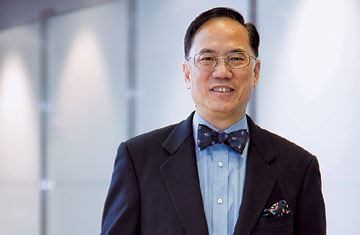
Donald Tsang, Hong Kong's Chief Executive
(2 of 3)
His political opponents say that Tsang has not yet shown the kind of world-class leadership Hong Kong needs and deserves. A former civil servant, Tsang was Financial Secretary under Britain's last Hong Kong Governor, Chris Patten, and No. 2 in the administration of Tung Chee-hwa, Hong Kong's first Chief Executive after the 1997 handover to China. Tung—who came from a Shanghainese family rather than from Hong Kong or its neighboring province, Guangdong—was never wildly popular and proved ineffectual, unable to meet the challenges of either a downturn in the economy or of the SARS epidemic that hit Hong Kong in 2003. In March 2005 Tung stepped down. Tsang became acting Chief Executive, and was confirmed in the job by the Election Committee in June that year (there was no other candidate then).
If only because he was not Tung—and because he was a local boy made good—Tsang came into office with much goodwill. But his first two years as Chief Executive were marked more by what he could not accomplish than what he did. In 2005, he was unable to push through a limited set of political reforms that would have increased the size of the body that picks the Chief Executive and added 10 seats to the legislature. The proposals were blocked by democratic lawmakers who felt the changes didn't go far enough and who objected, also, to the fact that Tsang's plan did not have a clear timetable for a transition to full democracy. "People wanted it; there was majority support for it," Tsang says of his plan. "Some bloody-minded politicians wouldn't allow it through in the Legislative Council—against the people's wishes."
Then there was the West Kowloon Cultural District, a $5 billion greenfield project to build a residential, commercial and cultural complex on 40 hectares of prime harborfront owned by the government. In a city where land is worth its width in gold, the scheme, launched by Tung, ran into legislative gridlock amid concerns of a sweetheart deal for the developer that would be chosen. Critics also questioned the government's wisdom—and expertise—in creating a costly arts hub without first gauging the level of public interest in it. Today, West Kowloon, possibly some of the most valuable real estate on the planet, stands idle—a dirt wasteland. Tsang has failed to advance other elements of his agenda, too. Air pollution, a perennial problem Tsang has vowed to combat, continues to choke the territory, harming public health and hurting Hong Kong's international reputation as a wonderful place to live.
His administration also lobbied hard to introduce a tax on goods and services, arguing that it needed to diversify its revenue base in case a major source of income, like government land sales, took a hit. But the proposal was roundly opposed by almost every segment of society. Retailers reckoned it would hurt their businesses. Economists believed it would unnecessarily complicate a straightforward tax regimen and deter foreign investors. And ordinary folk felt it would unduly burden low- and middle-income consumers. The government's gambit turned into an embarrassment when Financial Secretary Henry Tang, the moving force behind the gst, underestimated his numbers and revealed last month that Hong Kong had posted a surplus of $7 billion for the year, and would give back $2.4 billion of that in tax breaks. The upshot: the government didn't really need the extra cash.
Even Tsang's one major legislative success, getting the go-ahead for a new $665 million government headquarters on the harbor's southern edge, has run into criticism that the new development is unnecessary and will aggravate downtown gridlock. Tsang counters that his administration has been productive: "We have passed nearly 300 pieces of legislation of one kind or other. People just listen to one piece of law being a stumbling block, without realizing that a lot of things are going through every day." He admits that "some things I tried to do did not come through," but adds, "I am patient."