

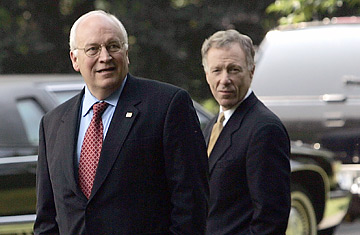
Vice President Dick Cheney (L) with I. Lewis "Scooter" Libby.
(3 of 3)
Even in his own family, Cheney has a reputation for simply not being there. At times he simply departs the room, not physically but mentally, says a family friend who has also worked for him. He loses himself in thought or a book or whatever he's doing and can't be raised or roused. When that happens, his daughters have a nickname for him: the Bull Walrus. And so they will wave their hands and affectionately call out their pet name for their dad--"Hey! Bull Walrus!"--as if he were sleeping on a big rock near the Arctic Sea. And then he'll come to.
PARDON ME, BOYS
So long as Bush remains Commander in Chief, however, and Cheney his faithful lieutenant, the Vice President's power will flow through the Oval Office. Cheney remains the Administration's point man in its war of words with Iran and helped persuade the President to send an extra carrier group to the Persian Gulf last month. He remains a force in White House debates about the conduct of the war, and though he has been forced to retreat in some areas, he has not walked away from the fight. He remains Bush's best messenger when delivering the tough love that Washington spoons out from time to time, as it did two weeks ago when the Administration pushed Pakistan's General Pervez Musharraf to take the war on al-Qaeda up a couple of notches.
Libby's four-count conviction guarantees that Cheney's White House role will remain in the news for most of the year. At the moment, Libby faces 18 months to three years in prison, though Judge Reggie Walton has discretion over the sentence he will hand down on June 5. In Libby's favor is the Columbia Law School grad's otherwise clean criminal record. Meanwhile, Libby's lawyers will try to argue for a new trial--something few observers expect Walton will permit--and then will ask the judge to allow Libby to postpone his jail sentence until an appeal can be heard. Retired Federal Judge Stanley Sporkin maintains that an appeal could be considered--and ruled on--in as little as six months, but it could stretch into 2008 if the appeal briefs are extensive. Given the way his lawyers tried to slow down the process with pretrial motions last year, they are likely to be.
And that's part of the plan. If his appeal fails, Libby's only recourse is a presidential pardon, and the chances of that go up as Bush's days in office dwindle. That means the longer Libby can keep the wheels of justice turning, the more likely he is to avoid spending any time in jail. Already the betting on a pardon is running at 65% by the end of Bush's term, and the Washington Post has announced a pool to predict the date. Democrats have called on Bush to swear off a pardon, but that outcome is not likely. If Bush ruled one out now, he might encourage Libby to seek leniency from Fitzgerald in his sentencing phase in return for cooperating with the prosecutor. In his first comments after the verdict was announced, Fitzgerald left the door open to such negotiations: "Mr. Libby is like any other defendant. If his counsel or he wish to pursue any options, they can contact us."
Then there is the argument that Bush should boot his Vice President before he strikes again. It's an often forgotten fact that three of the past six Presidents either dumped or tried to dump their Vice Presidents: Richard Nixon tossed Spiro Agnew for Gerald Ford in 1973, Ford tossed Nelson Rockefeller and tapped Bob Dole as a running mate in the 1976 campaign, and Bush's father George Herbert Walker Bush let his top aides try to give the heave-ho to Vice President Dan Quayle when he was dragging down the G.O.P. ticket by three or four points in 1992.
The father's instincts have never been the son's. Replacing the Veep now would create exactly the unpleasant succession scenario Bush had hoped to avoid when he chose Cheney in the first place. He didn't want someone soaking up all the attention and energy as he headed into his last 18 months in office. It seemed like a good idea at the time.