

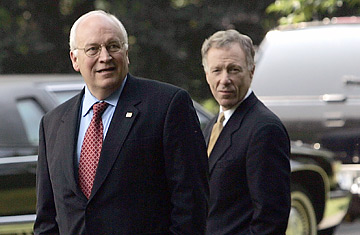
Vice President Dick Cheney (L) with I. Lewis "Scooter" Libby.
(2 of 3)
But the personal setbacks have merely been the counterpoint to the larger policy reversals Cheney has suffered in internal debates in the past year. Secretary of State Condoleezza Rice is executing an unmistakable course correction in U.S. foreign policy, quietly stepping away from the strident and unilateral positions of the neoconservatives and cutting deals with--or opening lines to--the remaining members of the axis of evil. Backed by a strong new team of career diplomats (see box), Rice prevailed on Iraq to invite Iran to a regional conference on security and then swiftly agreed to attend--unwinding Washington's vow just a few weeks ago that it would have no direct contact with Tehran until it stopped enriching uranium.
A few weeks earlier, after working for months with the Chinese, President Bush signed off on a deal with North Korea to freeze its primary nuclear reactor in exchange for economic aid and closer diplomatic ties. That deal was strikingly reminiscent of a controversial pact that Bill Clinton inked with North Korea in 1994--and that the Bush team criticized in the first term. When hard-liners inside the government complained to reporters that the White House was selling out to a dictator, Bush backed Rice in public. Even in intelligence matters, the area in which Cheney was once most dominant and in which he invited the most trouble in the Libby case, his hand has been weakened. For example, in public testimony before Congress lately, intelligence officials have emphasized more ambiguities and uncertainties in their conclusions about threats overseas than was commonplace at the height of Cheney's power. Democratic Senators report that a refreshing new degree of candor has returned in classified sessions as well. "Cheney's influence on intelligence has declined markedly," said Democratic Senator John D. Rockefeller IV of West Virginia, chairman of the Senate Intelligence Committee.
Cheney is hardly unaware of Rice's new dominance. A senior Administration official told TIME last week that Cheney has been part of all the arguments and has simply begun to lose some. But that alone means ideas that would have been unthinkable just a year or two ago--early engagement, muscular multilateralism, even patient negotiation--are becoming more acceptable in Bushland. American diplomats have asked the Jordanians for their notes on the Clinton-era negotiations between the Palestinians and Israelis, seeking to restart the Middle East peace talks that fell apart abruptly at the end of 2000. That's yet another turnabout for an Administration that lampooned those very talks in 2002.
Of course, some of the repositioning was inevitable, and most of it was long overdue. Even if Bush and Cheney didn't want to listen to the polls on the home front, they couldn't ignore the few allies they had left overseas. Britain's Tony Blair announced a partial pullout from Iraq last month, and then moderate Arab neighbors in the region began to clamor for Bush to pull up before he crashed. On Wednesday, King Abdullah II of Jordan made an impassioned public appeal in a joint meeting of Congress for Washington to take the lead on Middle East peace talks.
While Rice rewires foreign policy, White House chief of staff Joshua Bolten is showing signs that he can match Cheney on domestic matters. The Bush Administration has said it will retreat on the issue of domestic surveillance and abide by laws regulating wiretaps passed years ago by Congress. And the Democrats in Congress are finding Administration officials far more forthcoming with facts and figures about the conduct of the war in Iraq, in part because the White House knows that the next step--subpoenas--won't help their dwindling poll ratings. "There has been an ebb and flow," said Pennsylvania Republican Arlen Specter, "and the President has come to realize that the broader assertions of Executive power had to be tempered."
But there is another force driving the Bush team to pivot: the ticking of the clock. "It's very hard to do things at the very, very end," said Wendy Sherman, who coordinated North Korean policy in the Clinton State Department. "If the President wants to end eight years and have people say, 'You lost Iraq, you lost Iran, you lost North Korea, and you made the Middle East worse,' it's not a good moment in history. And so the pragmatists are predominant at the moment. This is their window."
THE BULL WALRUS
How did Cheney, a man once considered by members of both parties to have a feel for the golden mean, create a culture in which his top aide perjures himself? Some of it is his solitary roots: Cheney has never been a natural politician. He's more of a High Plains drifter who hailed from one of the least populated states in the nation, who took up the lonely job of utility lineman when he dropped out of college. Although he won a seat in Congress six times, he didn't have to work at it the way some lawmakers did. He easily rolled up huge margins in his Republican-tilted Wyoming district that literally covered the whole state. Personal charm wasn't so much Cheney's secret--the census was. In those days, everyone in Wyoming pretty much knew everyone else. Most years Cheney outpolled his rivals by more than 2 to 1.
So when he decided to give running for President a try in 1994, he soon realized he was unsuited for the big game. He raised a million dollars and built a good organization, but he found that the little things got to him. His fund-raising dinners, Cheney told aides, "weren't substantive enough." He didn't care to pal around with donors. He therefore called it off and never ran on his own again. This removal from people, from politics, from the sensors that make leaders responsive to people, turned into Cheney's Achilles' heel. And it actually deepened when he became Vice President. Bush picked Cheney because Cheney would never run again, but that also meant the newly minted Veep never had to put his ear to the ground.
Then came the war, which changed all of us but affected Cheney more than most. He was still wired in on everything, but that didn't mean he was in touch. He was convinced he was right about grave matters--that Saddam Hussein was a threat that had to be removed, that Iraq possessed weapons of mass destruction and was intent on using them, that critics of Administration policy were at best misguided and at worst traitorous. "It's always been a joke in his office that his staff is extraneous," said a staff member. "The only thing you can do is provide him with information he doesn't possess yet. He doesn't need your analytical skill and judgment. He has that already."