

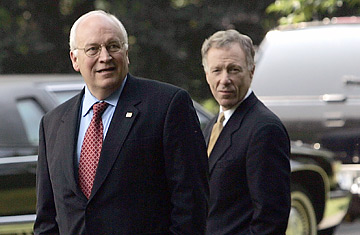
Vice President Dick Cheney (L) with I. Lewis "Scooter" Libby.
George Bush's sense of humor has always run more to frat-house gag than art-house irony, so he may not have appreciated the poetic justice any more than the legal justice on display in the Libby verdict.
Or, to be more precise, the Cheney verdict.
Bush stumped just about everyone seven years ago when he tapped the safe and solid Dick Cheney to be his running mate. But Bush didn't want any trouble. He didn't want a Vice President who preened before the cameras. He didn't want a policy sparring partner. And he didn't want someone who would check out after five years and run for President himself.
And because Bush got exactly the kind of partner he wanted, he now faces the very problem he tried to avoid. Cheney has become the Administration's enemy within, the man whose single-minded pursuit of ideological goals, creaking political instincts and love of secrecy produced an independent operation inside the White House that has done more harm than good. On an imaginary political balance sheet, Cheney is the Democrats' most valuable asset. And reversing that situation is getting close to impossible. Cheney recently made his weekly pilgrimage to the Senate, where he had lunch on March 6 with Republicans. He took his usual seat on one side of the stately Mike Mansfield Room and watched the proceedings quietly. Various Senators came by to ask him about his health after a blood-clot scare the day before. Others quietly lent support in the wake of that morning's four-count guilty verdict of Cheney's top aide, I. Lewis (Scooter) Libby. But for all the personal shows of support, more Republicans with each passing week have acknowledged privately what is felt across Washington when it comes to the Vice President: his time has passed.
And what a time it was. Back in the days of Bush's first term, aides to Cheney loved to regale journalists with tidbits about the scope of the Vice President's influence and the intensity of his commitment to protecting the U.S. from a terrorist attack. He was so driven and hands-on, the aides would say, that he and Libby would routinely ask to see raw intelligence rather than the processed analysis put together by the CIA and other agencies. "He's a voracious consumer of intelligence," said an admiring aide to the Vice President. "Sometimes he asks for raw intelligence to make his own judgment. He wants it all."
He may have come across as deferential to the President in public, but friends and advisers in the fall of 2002 described Cheney as nothing less than the engine of the Administration. "There's no way in which he is not driving the train on this," said one, referring to Cheney's role in pushing Bush and the Administration inexorably toward an invasion of Iraq. "Analysis, advocacy--it's all done by Cheney or his protégés or his former mentor [Secretary of Defense Donald Rumsfeld]. It's about context. It's reflective not so much of Cheney's direct influence on the President as it is of his influence on--his dominance of--the decision-making process. It's about providing the facts and analysis to the decision maker that the decision maker needs. Bush is making the decision, but the Veep is directing the process toward the decision that he thinks is the right one." In other words, Cheney had so rigged the process that important decisions were foregone conclusions, ones that had been reached by the Vice President well in advance.
So when the verdict against Libby came down, it was also a rebuke to that hermetic power-sharing arrangement at the top of the White House. The legal outcome was never in doubt. Federal prosecutor Patrick Fitzgerald had been massing evidence of perjury for months and then unveiled it piece by piece until even the defendant chose not to testify in his own defense. Libby's highly touted defense lawyers, meanwhile, seemed weak and scattered. Their promise to reveal how the White House had left Libby to be the fall guy for higher-ups was introduced and then abandoned. And it would have taken them down a road Libby steadfastly refused to travel--the one that led to the Vice President's door.
From the start, the case was only marginally about Libby. What was really on trial was the whole culture of an Administration that treated the truth as a relative virtue, as something it could take or leave as it needed. Everyone knows now that Bush and Cheney took the country into a deadly, costly and open-ended war on flimsy evidence of weapons of mass destruction. Yes, Congress went along. And yes, the public on balance supported it. But no one was more responsible than the Vice President for pushing the limits of the prewar intelligence that did all the convincing. And when former ambassador Joseph Wilson questioned the credibility of that intelligence--and the motives that helped polish it--it was Cheney who led the fight to bring him down.
None of that was illegal. So four years later, the Libby trial still prompts the question, Why did Libby get into legal trouble in the first place? Why did the Vice President's top aide not simply admit to what everyone knew was true--that he discussed the identity of Wilson's wife Valerie Plame, a CIA officer, with at least one reporter? Since most experts agree that Libby was unlikely to be prosecuted on a charge of revealing her identity, it is hard not to conclude that Libby cooked up his stories to protect Cheney. If Libby had gone a different route and admitted in his grand jury testimony that he had told a reporter about the identity of Wilson's wife, Fitzgerald's next question would have been, Were you acting on Cheney's orders? And it would not have been long before Cheney was giving testimony under oath. There was, said Fitzgerald in his summation, "a cloud over what the Vice President did."
THE YEAR FROM HELL
Libby's conviction comes at the end of a dreadful year for Cheney: last February he accidentally sprayed a friend with bird shot while hunting in Texas. A week before the midterms, in a gift to Democrats, he all but endorsed waterboarding on a North Dakota radio talk show as an interrogation technique. Mary Cheney, his openly gay daughter, ran afoul of conservative activists in December when it was revealed that she and her partner were expecting a baby. Late last month, while he was touring Bagram air base in Afghanistan, a suicide bomber attacked the camp's perimeter and killed at least 23 people in what the Taliban called an assassination attempt. Then on March 5, doctors found a blood clot in Cheney's leg, for which he will be treated with blood-thinning medication for several months.