

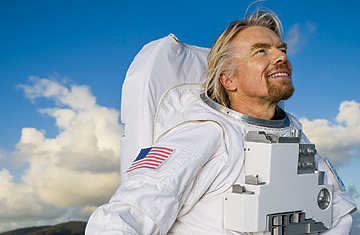
Sir Richard Branson, CEO of Virgin Group companies, on his private island, Necker Island.
(3 of 4)
Benson is probably the least known of the space entrepreneurs, although he collaborated with Rutan on the hybrid motor that rocketed SpaceShipOne into the history books. (Just who provided what expertise for the motor is no laughing matter. It's the center of a heated dispute between the two.) Benson, 61, is not new to new industries, having got his start in the nascent Internet world. In 1984 he created full-text indexing and search and sold Compusearch to an East Coast investment group for about $10 million. After a decade of work on satellites, he hopes to raise $50 million to mass produce the Dream Chaser. While Benson may not have the deep pockets of his rivals, he has aerospace experience: most of the moving parts on the Mars Rover came from his shops. His philosophy? "If we want to go to space to stay, space has to pay." The taxpayers have carried the burden for too long, he believes, saying, "We have to find something in space that is profitable and use that to grow the economy."
Luckily, space is a gold mine. A geologist by training, Benson points out that all those comets and asteroids tumbling around in near-Earth orbit contain water and minerals. Water's components--hydrogen and oxygen--are the building blocks of life and a darn good rocket fuel as well. Some estimates put the number of asteroidal water deposits at 5 million. Some metallic asteroids have 100 times the concentration of gold of any mines on earth today. (Earth's gold results from some of those asteroids crashing into the planet.) "While exploration is going on, we can use those natural resources. There is no life there, no ownership, no private-property rights," he points out. No rules--an entrepreneur's dream.
The man watching all these developments closely is Bigelow, a Las Vegas icon whom many compare with the early Howard Hughes, the aircraft enthusiast who started TWA, although Bigelow, who is in his 60s, isn't as eccentric, probably. Yes, in 1995, he founded the now defunct National Institute for Discovery Science to investigate paranormal activity and alien abductions, principally because his grandparents claimed to have had a close encounter with a UFO. But in 2002 he licensed exclusive rights to NASA's canceled TransHab inflatable habitat and set to work creating his own commercial space stations and hotels. Last July Genesis I shot into space, ballooned to limo size and began circling the globe with a box of Mexican jumping beans and some roaches on board as test subjects, making it the first private space station (and roach motel) in the universe. Genesis II, upgrading its passenger list to scorpions and ants, goes up in April--at about the time Bigelow says he will unveil his business plan to the National Space Symposium.
Bigelow's space habitat is admittedly more Budget Suites than Four Seasons right now, but his intent was never to be just an extraterrestrial hotelier. He has long talked of pharmaceutical companies doing research--particularly cancer research--in the microgravity environment of space. That Genesis even exists stuns the man behind TransHab's design, former NASA engineer William Schneider, who visits Bigelow Aerospace in North Las Vegas every few weeks to monitor progress on the full-size habitat, set for launch by 2010. "I went to humor him at first, but when I got there, he had built TransHab out of aluminum and had a small-scale [model] inflated," says Schneider. At full size, 45 ft. long and 22 ft. in diameter, it should hold three to six people in a shirtsleeve environment. TransHab launches in a compressed state, with fabric wrapped around a rigid core, then inflates "like a pup tent in the back of a car," according to Schneider. Bigelow has poured $75 million into the project so far.
Of course, you can't get to Bigelow's space station without a ride. No problem, since spaceport plans are popping up faster than airports--seven at last count, from Truth or Consequences, N.M., to Sheboygan, Wis. New Mexico Governor Bill Richardson has signed off on plans for a $220 million--to--$225 million Spaceport America to focus on space tourism.
New Mexico sees itself as a Silicon Valley of space, a place where an industry cluster could develop, absorbing investment and throwing off jobs as it does. When state economic-development secretary Rick Homans, chairman of the New Mexico Spaceport Authority, saw the list of global companies participating in the X Prize in 2004, he says it suddenly dawned on him that the new space industry might look just like the early computer industry--a bunch of crazy guys. "They start with chaotic, crazy inventors and entrepreneurs--colorful characters, some of whom are living hand to mouth, on the verge of going out of business." Critics have suggested that he's the one with the screw loose.
No one quite knows where it will all end up. "I have a hunch that the most important reason we're going to space is not known now," says Rutan, who also points to similarities with the early computer industry, which evolved from the Army's need to improve its ballistics calculations. He and Branson have 100 engineers looking at new technology for both orbital and suborbital flights as well as lunar flybys in a "glass bubble." On Necker, the two men pored over ideas for a plane that would fly orbitally, cutting flying time between New York City and London to 20 min. once in orbit.
You could understand why the chairman of Virgin Atlantic Airways would be interested in an orbital passenger jet. But why invest in what now looks like the world's most expensive amusement-park ride? "I hope that people going into space will come back and appreciate this beautiful world more," says Branson, turning philosophical about man's future on Earth. You almost believe him until he flashes that grin and adds, "If worst comes to worst, the Virgin Moon sounds pretty good. We'll colonize it!" Then Branson walks off the beach at Necker, shouting, "King Richard of the Moon! Lord Richard of the Galactic!" I swear, he means it.
[This article consists of a complex diagram. Please see hardcopy of magazine.] A $200,000 JOYRIDE Virgin Galactic is among several groups racing to offer anyone with the money a flight into space. The company's plan is based on the successful 2004 flights of SpaceShipOne, the world's first privately funded spacecraft.
1 Jet carries spacecraft to about 9.4 miles (15.2 km). Ship separates from aircraft and fires rocket. • SpaceShipTwo*
2 Ship reaches 3,500 m.p.h. (5,633 km/h) during 90-sec. climb up to 80 miles (130 km)
3 Passengers experience 4 min. of weightlessness • Cabin holds six passengers • Pilots
4 Flaps rotate upward to increase friction during re-entry
5 Ship glides, unpowered, back to Earth