

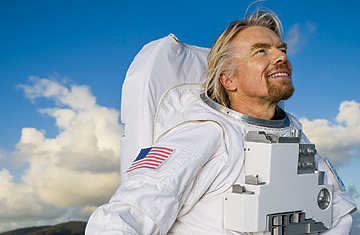
Sir Richard Branson, CEO of Virgin Group companies, on his private island, Necker Island.
This is, without a doubt, the sexiest setting ever for a meeting of aspiring astronauts: under swaying palm trees on the beach of a private island owned by Richard Branson in the British Virgin Islands. It is the week after Thanksgiving, and Branson is playing host to a "galactic get-together" on Necker Island. Beer and wine are being consumed like so much rocket fuel. Sushi floats in on a boat--to the middle of the pool. (Swimsuits required!) There's a casino party one night, a tennis tourney in the pouring rain and golf off the top deck of Branson's Balinese-inspired house on the hill--which you can do when you own the whole joint.
NASA's astronauts have buzz cuts and aeronautics degrees. But this group made its money in hedge funds and Internet ventures. There are babes too, barefoot and bikini clad, millionaires in their own right. Everyone is sitting in a circle on low beach chairs, wiggling toes in the white sand while debating the wisdom of getting into a centrifuge to test vomit potential at the high G-forces needed to soar into space. That's when the merry prankster himself, Sir Richard--master of Virgin Air, Virgin Records, Virgin stem cells, Virgin everything if he had his way--shows up and starts talking about sex in space. A vision of weightless gymnastics at zero G and intricate human docking maneuvers dances briefly in everyone's head. "Of course, if you want to get naked, someone might find out," warns Sir Richard, displaying a wolfish grin.
Welcome to the prelaunch program of Virgin Galactic, which hopes to be the world's first private spaceline, with liftoff by 2009. The adventure-addicted British entrepreneur says that over its first 10 years Virgin Galactic will send 50,000 civilians on a thrill ride more than 62 miles (100 km) up into space--to escape gravity and ogle our small fragile planet. Initial cost for the two-hour adventure? $200,000.
While Branson was hitting the beach with future passengers, his competitors-- smart, rich and innovative like him--were busily at work plotting to beat him into space. Amazon founder Jeff Bezos just tested his first prototype for personal space travel in West Texas. John Carmack, co-creator of the Doom and Quake games, is test-firing rockets for the next generation of spaceliners and lunar landers near Dallas. In California, Jim Benson, founder of Compusearch, is developing a space taxi with a motor that runs on rubber and laughing gas. (Don't laugh. It works.) PayPal co-founder Elon Musk, who has a NASA contract to build a robotic Pony Express to the International Space Station (ISS), is pouring his own millions into a ship for galactic travelers at his factory south of Los Angeles. Robert Bigelow, founder of Budget Suites of America, already has a small-scale, inflatable space station--hotel in orbit, an outgrowth of his curiosity about UFOs. New Mexico wants to become the Cape Canaveral of space tourism, but six other proposed spaceports across the country are vying for business too. There's even an Orbital Outfitters store to provide space suits for civilians--whether portly or petite.
Ever since Alan Shepard became the first American in space in 1961, NASA has controlled our mission in space. It became a sacred place, untouchable, a museum open only to select government employees. Fewer than 500 people have reached space since Shepard; Branson plans to double that number in Galactic's first year. NASA's idea of progress is to return to the moon, nearly a half-century later. Last year the agency spent nearly $5 billion sending highly trained astronauts to the ISS, largely to ferry supplies and fix the AC and other sputtering plumbing. The new generation of entrepreneurs is betting it can do what NASA does--only better and cheaper, with cushier seats and cool views for paying customers.
Far from fighting these space invaders, NASA is pushing such ideas as FedEx--like service to lunar outposts, private fueling stations in orbit and space tourism. "We're entering a renaissance period of space exploration," NASA administrator Michael Griffin said in January. Like the Renaissance, he said, wealthy entrepreneurs will--in fact, must--take the lead in commercializing technology.
Many NASA critics take it further. The agency's role, they say, should be to explore the far reaches of the universe by roving robot, leaving Earth's orbit and the moon to the private sector. "We're in this transition zone, where the Lewis and Clark role of NASA has been done on the human side," says space activist and rabble rouser Rick Tumlinson, founder of Orbital Outfitters. "Now it's time for the settlers and shopkeepers to move in."
The hyperentrepreneurial Branson, 56, has an unlimited appetite for outlandish promotional stunts, but launching the space-tourism industry with him on board the first Virgin Galactic flight would be tough to top. He is so confident, he plans to take his two kids, his 91-year-old dad and his 88-year-old mother with him. A Virgin Galactic prototype is taking shape on a hangar floor in California's Mojave Desert. New Mexico is negotiating leases with Virgin for its proposed spaceport, where space tourists could do some preflight vacationing. Designer Philippe Starck has been retained to add chic to Virgin Galactic plane interiors, hotels and spaceports. And despite the ticket price, sales are already closed for the first group of 100 passengers, called the Founders. "I'm absolutely sure that millions of people want to go into space," says Branson, "and it's up to us to make it affordable for those people."
His success depends on Burt Rutan, a brilliant if iconoclastic aircraftmaker whose unconventional designs can be found in everything from Predator drones to do-it-yourself airplane kits. Rutan's $26 million SpaceShipOne proved in 2004 that a privately built vehicle could reach the edge of space and do it twice in five days safely. The plane, bankrolled by former Microsoft co-founder Paul Allen, won the $10 million Ansari X Prize (sponsored by a foundation seeking radical breakthroughs in space travel) that year and removed, once and for all, what Carmack calls the "giggle factor" in private spaceflight. "This is real. We're not dreaming anymore," Branson says, all signs of his Necker Island playfulness gone. "You could argue," he says, taking a swipe at NASA, "that we've wasted 50 years."
In 2005 he and Rutan formed the Spaceship Company--a Boeing for the new space age--with Virgin placing orders for the first 12 ships. Branson is betting $250 million just to get Virgin Galactic started. Rutan plans to build at least 40 spaceships and expects to be run ragged by other clients. "I know this is an interim step," says Rutan, 63. "Fifteen years from now, every kid will know he can go to orbit in his lifetime."