

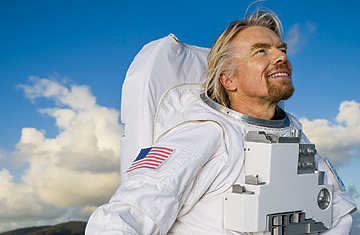
Sir Richard Branson, CEO of Virgin Group companies, on his private island, Necker Island.
(2 of 4)
Most of Branson's competitors are intent on rocketing right off the launchpad. But Virgin Galactic's SpaceShipTwo flies in lazy circles up to 50,000 ft.--spy-plane territory--attached to a huge turbojet launch plane. Then SpaceShipTwo drops away and rockets off into space at 3,500 m.p.h. on its laughing-gas engine. Aboard the spaceship the two pilots will cut the rockets and the ship will coast up to 80 miles, well outside the atmosphere. For 4 min., the six passengers (now astronauts!) can unstrap and float weightless around the cabin. Earth will look like a shiny ball with white swirls surrounded by a totally black sky. Diving back into the atmosphere will be a wild ride, peaking at nearly 6 Gs--twice the rush you feel on the average roller coaster. Rutan's genius is his "carefree re-entry" design: SpaceShipTwo folds up its wings for re-entry then transforms into a conventional glider for a gentle slide home to the runway.
On Necker Island, Branson gathered some of the Founders to meet Rutan and chat about spaceship design, safety issues and preparation possibilities for the G-forces and sensory overload of a first-time astronaut--like how to puke in space. They debated who would be the first paying customers. The hedge-fund honcho from California? The Internet couple from England? The hot German babe in the bikini? Or the guy from New Zealand who changed his family name to Rocket? Physicist Stephen Hawking, who believes that mankind must colonize space, sent word that he wants in--which would allow him to slip the earthly confines of his wheelchair. One of the royals (Prince Harry, Princess Beatrice?) is a possible passenger, not to mention publicity bonanza. Pilot Alex Tai, Galactic's chief of operations, claims that the market--even at $200,000 a shot--is huge, with 8 million millionaires worldwide, a couple of whom have already spent $20 million each to fly with the Russians. Branson wants to keep bringing the price down, so middle-class families can vacation in the ether. By year two, deposits will be down to $20,000, says Tai, heralding "the democratization of space."
And the beginning of market competition. The Benson Space Co. is developing the Dream Chaser space taxi--a "cute little sports-car-like spaceship" that seats six and has rocket motors in the trunk. It harks back to a design developed by the Soviets for space-shuttle runs but adds an innovation: the same hybrid motor used by SpaceShipOne to win the X Prize in 2004--laughing gas shot through rubber. In comparison, the spaceship being developed in great secrecy by Bezos' Blue Origin looks like a lopped-off nose cone. The three-seater, fueled by hydrogen peroxide (yup, the common household disinfectant, though in a highly purified form, with a touch of kerosene) appears based on an old Delta Clipper design done for NASA. Musk's SpaceX designers favor the NASA look too--of old Apollo capsules--but that translates into ocean splashdowns.
The oddest-looking suborbital ride, however, is by John Carmack, who is building podlike contraptions that sometimes land on all fours. Sometimes not. The Pixel, made for one, is a platform atop four tanks of fuel (liquid oxygen and ethanol). He's not strapping anyone in yet, right? "Funny you should say that," he says, picking up a motorcycle saddle at his Armadillo Aerospace shop one evening. "It goes on top of the electronic box over here. We did a parking-lot flight a couple of years ago and roughed up one of our earlier vehicles." Not to worry, he says jokingly: there will be a glass top over the saddle seat. At least he sounded as if he was joking. Pixel has made more than 30 unmanned test flights and could begin carrying commercial payloads next year.
Musk and Carmack represent the opposite extremes of the business. Musk already has a working business, operating SpaceX since 2002 out of a warren of old repair shops and warehouses in El Segundo, Calif., an area with a long aerospace history. He plans to move soon to nearby Hawthorne, into a cavernous plant that once turned out 747s. He has set aside half of his $200 million PayPal payout and has hired close to 250 people, from such outfits as Boeing and Grumman as well as from Silicon Valley.
While most of his competitors have shunned the bureaucratic NASA, he bid for and won a $278 million NASA contract to develop a delivery service to the ISS. For Musk, 35, space travel is a childhood dream, not just for exploration but as a logical next stage in man's evolution from the primordial goop. "To our knowledge, life exists on only one planet, Earth. If something bad happens, it's gone," he says. "I think we should establish life on another planet--Mars in particular--but we're not making very good progress. SpaceX is intended to make that happen."
In contrast, Carmack, 36, says he is just a computer guy who got bored and taught himself rocket science. Yet in aerospace circles, the gamer and head of id Software is respected for doing results-oriented rocketry work on little dime. His shop in a suburban Dallas business complex looks like something out of Star Wars--Watto's junk shop on Tatooine, to be precise. Carmack takes you first to see his graveyard of old projects to explain his philosophy: Fly a whole lot, and learn where the gotchas are. He admits that he would like to go to the moon someday, but he doesn't waste his time dreaming. "It's pointless and a distraction. You get people with stars in their eyes looking at ways to conquer the solar system," he says. "I spend more time worrying about which part I have to make next."
The man with the most secretive business plan is Amazon boss Bezos, who launched his Seattle-based Blue Origin in 2000 and started buying up a huge swath of land in West Texas near Van Horn, arousing the suspicions of locals. Bezos plans to build a spaceport and aerospace testing center at the desert site but is taking it "slow and steady." (His company motto is Gradatim ferociter, which roughly translated means "Step by step, fiercely.") It's unclear how much funding Bezos, 43, is putting into the venture, but he has been doing it the NASA way, spending huge amounts of money to hire engineering Ph.D.s.
In January he lifted the veil somewhat, releasing a video of the first test flight last November--a cozy affair on his ranch, with a Jumbotron for the spectators, a bouncy castle for the kids and a chuck wagon. The scaled-down prototype flew up 285 ft.--and 30 sec. later landed successfully. "My only job at the launch was to open the champagne, and I broke the cork off in the bottle," he blogged later. (You can almost hear that mad-scientist laugh of his.) "Fortunately, our other valve operations went more smoothly."