

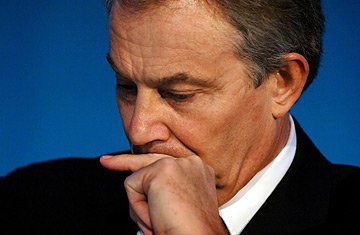
Prime Minister Tony Blair addresses a productivity public services summit hosted by the CBI in London.
(3 of 4)
Still, while the affair has its concealed agendas--Iraq and a loathing of Blair's support for George W. Bush, a President Britons rate as substantially more dangerous to world peace than Kim Jong Il--the Prime Minister is the author of his predicament. His troubles have their roots in the days when his party reveled in a deep-seated hostility to the running dogs of capitalism. "In 1983 we still had a manifesto committed to nationalizing key parts of industry, promoting an agenda that was set against every interest of British business," says Ed Owen, a former government adviser. After being crushed by Margaret Thatcher in that election, says Owen, Labour decided that it had to prove it was "now the party that would provide the means by which industry and business could flourish." But Labour lost elections in 1987 and again in 1992, when it was defeated by the unpopular Tory government of John Major, itself mired in accusations of sleaze. Katwala calls that last outcome "astonishingly traumatic," and Labour's coming generation--Blair to the fore--set about ensuring that the party could never again sink so low. The result, says Katwala: "a degree of overcompensation" in the courtship of the business vote--and its cash.
Labour needed that cash. At the beginning of the 1990s, the party was close to bankruptcy. Most of its income came from labor unions, but union membership had dwindled, and party membership, another source of funds, had more than halved from a high in the 1950s of 1 million. (It is now less than 200,000.) Blair took over the helm of the party in 1994 and with the help of Levy, a self-made multimillionaire who started his fortune managing middle-of-the-road rock bands, began romancing the business community. The strategy paid off handsomely; business rushed to back Blair as his star rose, and his party triumphed.
Early on, there were hints that this new friendship did not always smell as fresh as it might have. Just six months into Blair's premiership, Labour was forced to return a $1.7 million donation from Bernie Ecclestone, boss of Formula One motor racing, after suggestions, denied by both sides, that his largesse might have influenced the government's decision to exempt the sport from a ban on tobacco sponsorship. But back then, Blair was untouchable. "I'm a pretty straight sort of guy," he told the BBC's Humphrys in an early encounter. Today that sort of charm doesn't wash with a public made cynical by revelations about dodgy dossiers on Iraq's weapons of mass destruction.
A similar disaffection greets Labour's protestations that it has already introduced reforms to the funding of politics and is considering more of them. "We dined out on this legislation to make the system more transparent. We quite rightly took credit for being the first government to do so after the years of John Major's sleaze," says a Labour insider. "So even the perception that we are seeking to evade our own legislation is terribly damaging." Proposals to restructure the House of Lords and tighten procedures for appointing peers, arrived on Feb. 7, clanging like a door on an empty stable.