

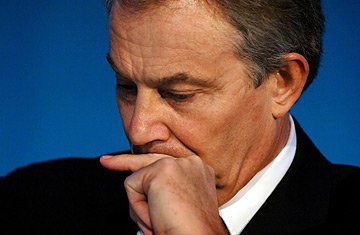
Prime Minister Tony Blair addresses a productivity public services summit hosted by the CBI in London.
(2 of 4)
On the face of it, this is a simple story. Last year political opponents of the government asked the police to investigate reports that Labour Party sources might be offering honors such as knighthoods and peerages in return for donations to the party. That would contravene a 1925 law drawn up to ban the peddling of titles after Liberal Prime Minister David Lloyd George, a venal realpolitiker, exploited his powers of patronage for the benefit of party coffers. Four wealthy businessmen--all recommended by Labour for peerages, although their names were later withdrawn from contention--admit that they secretly made loans to Labour before the 2005 general election but say the cash was given on commercial terms and so did not have to be disclosed. In April 2006, the police extended their inquiry to look at the finances of all the main political parties and began to interview witnesses. That month a government adviser called Des Smith--who allegedly told an undercover reporter that financial backers of privately subsidized schools called city academies could expect to be rewarded with honors--was the first to be arrested. (And the first to be let off: prosecutors have now said there is insufficient evidence to pursue charges against him.) Last July, Blair's friend and fund raiser Lord Michael Levy was also arrested and, like all other parties in the investigation, denies any wrongdoing. Since then, the inquiry has trudged along at a snail's pace, entwining more Downing Street employees and providing media sensations in thin news weeks. One of Blair's close associates says Downing Street had made contingency plans in case charges were leveled before last September's Labour Party conference, a sign of how long this has dragged on. Another member of Blair's inner circle speaks of "death by 1,000 leaks."
The police deny they are the source of the rumors and theories swirling through London, and even hardened conspiracy theorists--never in short supply in London's clubland--find it hard to explain what the boys in blue would stand to gain from such indiscretions. Still, each week, the stories pop up--and are then denied. One of the Prime Minister's advisers is said to have an explosive personal diary of events (he denies it); Downing Street is said to have a second, secret e-mail system ("stuff and nonsense," says an aide). But the idea that there's no smoke without fire is deeply rooted in British public life, and a pall hangs over Downing Street. "Britain remains a very clean political system, but you have this public sense of something being up," says Sunder Katwala, general secretary of the Fabian Society, a left-of-center think tank. He speaks of a "corrosive lack of trust" that is undermining the credibility of the political system. There's little evidence that voters are worried about whether honors were waved hypnotically in front of round-eyed donors. Three-quarters of respondents to a new poll say "these kinds of things have always gone on." But after close to a decade in office--and with the horror of Iraq, for which Blair is personally blamed--many in London's always frenzied media-and-politics village have decided that enough is enough. "What [this scandal has] become is a symbol of disengagement," says Katwala. "There's a strong link being made in the media by people who feel Iraq is still unfinished business and that this might be the next big thing. Is this where Blair gets caught?"