

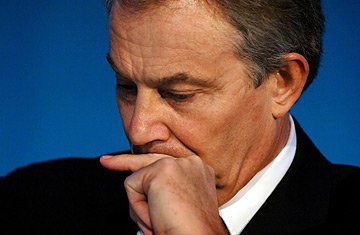
Prime Minister Tony Blair addresses a productivity public services summit hosted by the CBI in London.
Delivering responses as crisp as his shirt--and displaying a confidence as miraculously uncreased after months at the center of a storm over alleged corruption--Tony Blair on Feb. 6 submitted to a very public interrogation. He has twice answered police questions--as a witness, not as a suspect--in Britain's so-called cash-for-honors affair, becoming the first serving Prime Minister to be grilled by the cops. But this was his biannual appearance before a top parliamentary committee, a set-piece occasion that always provides insights into government policy. This time, as the chief witness genially pointed out, one question alone sent members of Westminster's low-tech press corps scrambling to uncap their pens--a question that dominates politics in Britain: When will Blair go?
The Prime Minister has already given a general answer: soon. Back in September he promised to relinquish the keys to 10 Downing Street before this fall. He declared an intention more recently to carry the flag for Britain at the G-8 and European Union summits in June. That indicates a narrow summer timetable for the anticipated swift transition of power to his Chancellor of the Exchequer, Gordon Brown. But as Blair looks forward to the 10th anniversary of his first election victory, on May 1, London's famous chattering classes are wondering if he'll make it that far. An alliance of raucous opponents on the right and left, amplified by the noisy media, demands his head now, saying he should resign pending the police investigation into allegations that honors, such as seats in the House of Lords, may have been offered in exchange for party funding. Blair is keeping his head down and continues to work to secure his legacy as one of Britain's most successful premiers ever--presiding over continuous economic growth, pushing through record spending on health and education, moving within sight of a peace deal in Northern Ireland. He might have expected to string out his departure like the kind of grizzled rock stars whose company he evidently enjoys, squeezing in a few, poignant farewell gigs. Yet the loudest voices in the crowds are baying for him to leave the stage.
Blair isn't ready to just disappear. "You'll have to put up with me for a bit longer," he told the BBC's famously pugnacious interviewer John Humphrys last week. And at Downing Street, which always looks more like a film set than its screen simulacrums, people are doing their best to act out that message of business as usual. An aide reels off the day's wearying list of prime-ministerial meetings and appointments, before revealing the anguish behind this glassy efficiency in a voice lowered to a whisper: "It reminds me of the end of the Clinton era. It's a witch hunt."
The scandal threatening the reputation of a man once known as Teflon Tony involves alleged impropriety behind closed doors. But the police inquiry launched in March 2006 isn't concerned with besotted interns or sexually promiscuous leaders. Blair and the New Labour Party he created in his dapper, middle-class image are suspected of getting too close and personal with money.