

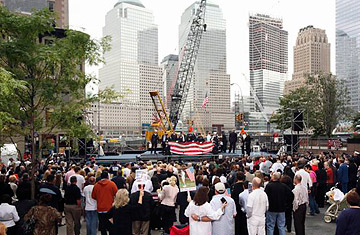
A tattered flag from Sept. 11, 2001 is brought to a stage near the footprint of the World Trade Center
(5 of 6)
--THE NEXT ATTACKS
Where are future assaults likely to take place? Last week's incidents suggest an answer. As a senior French investigator says, "International jihad places priority foremost on the lands of Islam." By focusing on targets in the Islamic world, terrorists get a double benefit. They can hit Westerners--tourists in Bali, diners in Casablanca. And they can damage the governments of Islamic states they consider to have strayed from the true path and to have allied themselves with the U.S. Andre Azoulay, an adviser to King Mohammed VI of Morocco, views the Casablanca bombing as an attempt to punish "the only Arab state that has made the growth of a democratic, pluralistic and harmonious multireligious society a stated policy. Our openness and freedom as a society is what they fear the most."
The recent attacks on the Saudi kingdom were no surprise to U.S. counterterrorism officials. In February the CIA warned the ruling royals of the possibility of imminent assaults. Washington had also grown concerned that the Saudis had not done all they could to cut the cash flow to terrorists. Earlier this year Cofer Black, the State Department's head of counterterrorism, visited the kingdom to give the princes "substantial and highly sensitive information" showing that "Saudi charities had been corrupted for terrorist purposes," a senior Administration official tells TIME. A U.S. dossier named prominent Saudi businessmen and charities like the al-Haramein Foundation, long suspected in Washington of being a source of funds for terrorism. The exercise involved a level of intelligence sharing, says the U.S. official, that had not been offered before.
In mid-April Black was back in Riyadh accompanied by David Aufhauser, general counsel to the Treasury Department, to follow up. By then, a source tells TIME, the U.S. had heard "chatter" that seemed to indicate that "some people felt that they had won a green light for operations inside Saudi Arabia." Black told Saudi officials Washington had good information that an attack on Americans in the kingdom could come within weeks. By May 1, the very day Bush was speaking on the U.S.S. Abraham Lincoln, the State Department issued a warning against travel in the region. Two days later, according to someone who was present, U.S. Ambassador Robert Jordan told a gathering of Americans in Riyadh "with painstaking bluntness" that if they could, they should leave.
As the chatter picked up steam, Stephen Hadley, U.S. Deputy National Security Adviser, made an unscheduled stop on May 2 in Riyadh to convince the Saudis of the seriousness of the situation. He asked for enhanced protection, including armed military guards, at all Western facilities in the kingdom. The Saudis, U.S. officials tell TIME, said there were more than 300 such locations and pleaded, Couldn't the U.S. be more specific about the threat? "It appeared that we had the interest of the senior leadership," says a U.S. official, "but there was no follow-up." On May 7, after the Riyadh safe house was raided, Jordan called for tighter security and in a follow-up on May 10 specifically appealed for more protection at al-Jadawel. After inspecting the compound, Saudi authorities decided security was adequate.