

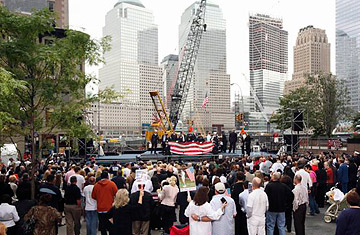
A tattered flag from Sept. 11, 2001 is brought to a stage near the footprint of the World Trade Center
For Scott Schlageter, 35, an American procurement manager for the Saudi air force, it was just another expat's night in Riyadh. He was watching an Antonio Banderas thriller, curled up on the sofa in his home in al-Jadawel, a gated town-house complex in the Saudi Arabian capital. Suddenly the lights died, and the TV zapped off. Schlageter saw a flash and felt a thundering explosion that blew out all his windows. "I grabbed my cell phone, went upstairs to a secure room, called the U.S. embassy and told them we were under attack," he says. A vehicle loaded with explosives had blown up at the gates of the compound.
At that very moment, similar assaults were under way in two other residential areas. Four miles away, at a complex that housed dozens of Americans employed by Vinnell Corp. to help train the Saudi National Guard, a pair of cars were on a deadly mission. The first, a Ford Crown Victoria sedan filled with terrorists armed with Kalashnikov assault rifles, sped up to the compound's security checkpoint. The men mowed down the guards and removed a 3-ft.-high steel barrier
that protected the compound. The second vehicle, a Dodge pickup loaded with explosives, followed close behind. It barreled into a central area and exploded between two five-story buildings. At the nearby al-Hamra complex, two other explosives-laden vehicles were detonated near a pool where a party was in progress. By the time the smoke cleared from the three assaults last Monday, 34 were dead, and 200 more were wounded. The dead included nine Americans and nine of the assassins.
Terror struck again just four days later. In the Moroccan city of Casablanca, five suicide bombers hit within 20 minutes of one another, spreading death and destruction across an array of targets: a Spanish social club, a hotel, a Jewish community center and cemetery, a restaurant next to Belgium's consulate. Nearly half of the 41 who lost their lives had been at the club, Casa d'Espana, where two suicide bombers muscled in after slitting the throat of a guard. Within a day, Moroccan authorities had rounded up a number of Islamic militants and had in custody one man who had been detained before his bomb exploded. More attacks seemed likely, and both the State Department and the British government warned people to stay away from East Africa.
Before Riyadh and Casablanca, it was tempting, if just for a moment, to believe that the war on terrorism was going well, that the big picture was of one success after another. The U.S. had notched a quick victory in Iraq, deposing a regime the Administration had linked to extremist Islamic terrorists. The much feared retaliatory strikes didn't take place, and no attacks had hit the U.S. after Sept. 11, 2001. Several key leaders of al-Qaeda, the network headed by Osama bin Laden that carried out the Sept. 11 attacks, had been arrested. Just days before the bombings in Riyadh, President Bush stood on the deck of the U.S.S. Abraham Lincoln to bask in his Iraq triumph and declared, "The war on terror is not over, yet it is not endless. We do not know the day of final victory, but we have seen the turning of the tide."