

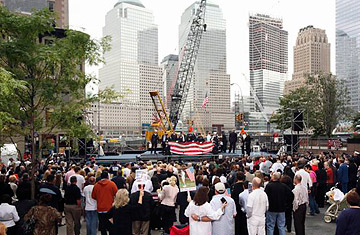
A tattered flag from Sept. 11, 2001 is brought to a stage near the footprint of the World Trade Center
(2 of 6)
Then reality returned with a vengeance. After the latest blasts, no one is talking about turning any tide. Instead, the world is focused again on mourning, on soul searching, on how to deliver an effective response. Make no mistake about it: Islamic extremists are still angry enough, and organized enough, to cause considerable damage to the U.S. and its allies.
Was it al-Qaeda again? Although there is not yet definitive proof, the attacks in Riyadh, American officials say, bore all the hallmarks of the organization. A source tells TIME that a full nine months ago, U.S. intelligence picked up signs of an intense debate within an al-Qaeda cell in Saudi Arabia over whether to stage a major operation inside the kingdom. Bin Laden himself may have contributed, at least from afar, to the debate. In an audiotape sent to the Arab TV network al-Jazeera in February, a man claiming to be bin Laden called on "honest Muslims" to "liberate themselves from those unjust and renegade regimes that are enslaved by the United States." Among the "most qualified regions for liberation," the speaker continued, were Saudi Arabia and Morocco.
There was other evidence that last week's attacks may have been linked to al-Qaeda. Just days before the Riyadh bombings, Saudi police botched a stakeout on a safe house just outside al-Jadawel where they believed terrorists had congregated. Weapons were found, but the men got away. Saudi authorities quickly released the names and photographs of 19 alleged terrorists. Two of the suspects--Abdulrahman Mansour Jabarah and Khalid al-Jehani--seem to have al-Qaeda links. Jabarah is the elder brother of Mohammed Mansour (Sammy) Jabarah, a Kuwaiti Canadian now in U.S. custody who allegedly took part in a foiled al-Qaeda plot to blow up embassies in Singapore. Al-Jehani, identified by some as al-Qaeda's chief of operations in the gulf region, appeared cradling a Kalashnikov in a famous al-Qaeda martyrdom video found in an Afghanistan safe house in 2001. Al-Qaeda may well be responsible for the Casablanca bombings too. A senior Moroccan official says interrogations quickly established that the terrorists were "indoctrinated, trained, organized and put into motion by foreign members of the international jihad movement." He added, "We're talking about al-Qaeda here."
From the moment it bombed two U.S. embassies simultaneously in Africa in 1998, al-Qaeda showed it had the skill, resources and personnel to coordinate terrorist outrages on a scale never seen before. Since 9/11, the organization has been under constant pressure. International cooperation among law enforcement authorities is far more effective. The terrorist training camps in Afghanistan and the safe haven al-Qaeda constructed there have been dismantled. But the network remains formidable, U.S. officials say. "Al-Qaeda still retains the ability to plan and launch terrorist attacks, including in this country," says a U.S. official.