

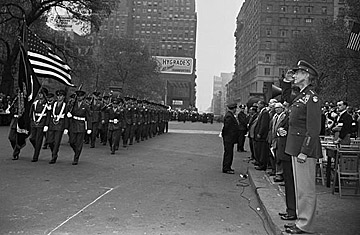
October 20, 1953: Gen. Mark Clark with Mayor and Grover Whalen reviewing Korean Vets who are parading in City Hall Plaza.
Truce came to Korea in a stark, deliberately underplayed ceremony.
At Panmunjom, shortly before 10 a.m. (the hour fixed for the signing), nervous little Communist sentries in baggy pants and wilting red epaulettes scurried about, brushing off the board walk where their masters were to tread. The bleak, new truce building, hastily and especially erected by the Reds, smelled of fresh pine. Outside, it still showed the marks of two big Picasso-style peace doves, put up by the Reds, taken down at Mark Clark's demand. Inside it was stifling hot. Sweating U.N. observers and correspondents, including officers from each national contingent, filed in and sat on metal chairs at one side of the hall; the Communist group sat at the other side. U.N. and Communist guards stood motionless around the walls. There were three large tables, one for documents, a second bearing a U.N. flag on a brass stand, the third with a North Korean flag similarly mounted.
Promptly at 10, the two chief actors entered. Lieut. General William K. Harrison, the U.N. senior delegate, tieless and without decorations, sat down at a table, methodically began to sign for the U.N. with his own ten-year-old fountain pen. North Korea's starchy little Nam II, sweating profusely in his heavy tunic, his chest displaying a row of gold medals the size of tangerines, took his seat at the other table, signing for the enemy. Each man signed 18 copies of the main truce documents (six each in English, Korean, Chinese), which aides carried back & forth. The rumble of artillery still rolled through the building. Flashbulbs blazed and cameras whirred as the two chief delegates silently wrote. When they had finished, West Pointer Harrison and Nam II, schoolteacher in uniform, rose and departed without a word to each other, or even a nod or a handshake.
Without Fireworks. Outside, a correspondent asked a British officer whether the Commonwealth Division would celebrate with the traditional fireworks. "No," said the Briton, "there is nothing to celebrate. Both sides have lost."
Thus, 37 months and two days after the Russian-trained North Koreans attacked across the 38th parallel, the Korean war—a devastating struggle, laced from the start with glory, agony, triumph, frustration—came to a halt, perhaps temporary, perhaps permanent. The war had cost the U.S. more than 140,000 casualties (some 25,000 dead, 102,000 wounded, 13,000 missing and captured), $22 billion. The problem of ending it had roweled the best brains of two U.S. Administrations, and had helped to win a national election for one, to lose it for the other.
Dull and Resigned. The almost-forgotten men of the war—the U.N. prisoners still in Communist hands—were expected to start coming back through the Panmunjom exchange site within a week. The latest prisoner list tendered by the Reds showed 3,313 Americans, 8,186 South Koreans, 922 British Commonwealth, 342 others. Enemy prisoners who had opted for repatriation were to be brought north at the rate of more than 2,500 a day.