

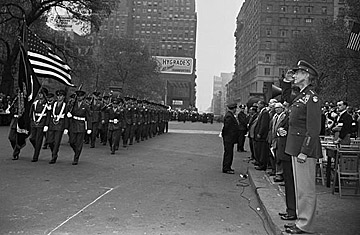
October 20, 1953: Gen. Mark Clark with Mayor and Grover Whalen reviewing Korean Vets who are parading in City Hall Plaza.
(2 of 2)
Syngman Rhee, Korea's veteran fighter for freedom, sat on a stone bench in his garden at Seoul. He still spoke against the truce, but his talk now was dull and resigned. There had been some fear that his ROK troops might refuse to withdraw from the buffer zone—but they ceased fire along with their U.N. comrades in arms (see below). Syngman Rhee, whose opposition might have wrecked the truce if the Communist hunger for a truce had not been voracious, now declared: "My desire is strong not to follow unilateral policy if it can be avoided."
Up to the last, irritations and uncertainties had persisted.. General Mark Clark, who flew from Tokyo to Seoul in his Constellation, had expected to sign the truce at Panmunjom, with Kim II Sung and Peng Teh-huai (the North Korean and Chinese commanders) as the other signatories. But for this, the Reds made unacceptable conditions: no South Koreans or reporters could be present.
So Clark signed alone in a tin-roofed movie hall at Munsan, the allied truce base, three hours after the Panmunjom signing, and Kim and Peng presumably signed in their own lair at Pyongyang. Behind Clark, ramrod stiff, jaws clamped tight, sat ROK Major General Choi Duk Shin. Spotting him after the signing, Clark said, "I'm glad you came." "Thank you," said General Choi.
It was then that Mark Clark, seeming to think a few words required of him before the reporters and cameramen, said: "I cannot find it in me to exult at this hour."
Complex Justification. Only in this single remark did some of the private bitterness of the U.N. command reach the surface. The top commanders, like everyone else, were glad that the bloodshed was ended, but they took no pride in their achievement, and they felt no satisfaction in the armistice they were ordered to sign. They knew the argument that in this war freedom had been defended and aggression repelled, but, cabled TIME Correspondent Dwight Martin, "they all seem concerned that some day they will be called on to explain why they signed the present armistice. Several I've talked to specifically think in terms of investigating committees demanding to know whether it is a fact that they sold out Korea. They frankly admit that complex justifications and explanations, currently acceptable, may look pretty lame in a year or so."
*Eighty-five per cent of the wounded later returned to duty.