

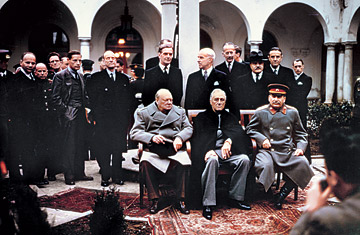
At Yalta in 1945, the Big Three formalized plans for occupation zones in Germany. Stalin, above right, also agreed to join the U.N..
(2 of 2)
These initial irritations were probably not so serious as they seemed. In a speech asserting the principle of French equality last fortnight (TIME, Feb. 19), De Gaulle himself reminded the French people that they still have to earn the right to actual equality. All concerned faced the same hard facts: France cannot recover without Big Three help; the Big Three cannot run liberated Europe and postwar Germany without a resurgent, reasonably satisfied France.
Concert of Spheres. In the first glow, some optimists had read more into the Big Three declaration on liberated Europe than the Big Three actually said. Even among the Big Three, contests for power and spheres of influence were not finally abolished at Yalta. Yalta could be taken as an incomplete check on a race for spheres of influence.
In principle, the Big Three agreed to "concert" their interests and policies in such troubled countries as Greece and Poland. But the statement of principle included some significant limitations: 1) it holds good only "during the temporary period of instability"; 2) the big powers are bound to act together only when all three agree that the specific circumstances of each case justify their joint intervention.
Concert of Votes. The sorest point settled at Yalta was the dispute over voting procedure in the postwar world Security Council.
Joseph Stalin did not budge an inch from his insistence that any one of the Big Powers must be able to veto world action against itself or against any other country accused of aggression. But the compromise engineered by President Roosevelt was neither so cynical nor so futile as it seemed to some commentators.
Under the compromise, the Security Council's Big Five (the Big Three plus France and China) must agree unanimously before the world organization can take economic or military action against an aggressor. But any seven (nominally, two-thirds) of the Council's eleven members can cite an aggressor nation, bring its sins to world attention.
The provision requiring a two-thirds vote instead of a simple majority to do this is a marked concession to the smaller powers. It means that the Big Five, even when united, cannot commit the world organization to any action without approval of at least two of the Council's little-nation members. At least in theory, six smaller members could join forces with one of the Big Five to override the other four in preliminary decisions.
When the United Nations convene in April to revise the original Dumbarton Oaks proposals, these considerations may outweigh the right of veto retained by the Big Powers. Everyone in San Francisco will know that, anyhow, whatever the rules, no nation could be made to declare war on itself.