

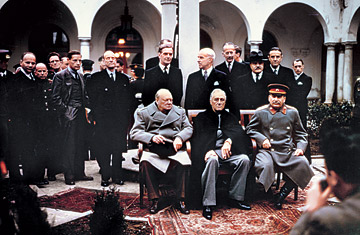
At Yalta in 1945, the Big Three formalized plans for occupation zones in Germany. Stalin, above right, also agreed to join the U.N..
No doubt about it—the Russians were changing. At Yalta, as at earlier conferences, Stalin and other Soviet bigwigs shed a little more of their personal isolation.
Stalin mugged the cameras, patently loved to show off his fine grey uniforms. His stock of English phrases had grown: "So what?" and "You said it" had been added to "The toilet is over there!" and "What the hell goes on here?" Now one of his problems is the ingrained aloofness of Politburo men and others in the Soviet hierarchy who feel that Russia is having too much truck with foreigners.
But the international yeast was working. Perhaps it had something to do with Yalta's implications for the future:
Deed of Trust. Stalin, Roosevelt and Churchill bluntly said that the three powers who had "made victory possible and certain" proposed to administer the victory. Big Three unity for this purpose was "a sacred obligation which our Governments owe to our peoples and to all the peoples of the world."
This assertion of high purpose had some very practical roots. It was a logical expression of Stalin's cold certainty that only power counts (said he once of the Pope, "How many divisions has he got?"). It was an equally natural extension of President Roosevelt's recent assertion that the U.S. intends not only to take a responsible part in world affairs but to shape the decisions for which it shares responsibility. For Winston Churchill, the doctrine of trusteeship was insurance that a Britain exhausted by the war will have a position in keeping with Britain's needs.
But Big Three assertions alone cannot make trusteeship work. That will also require the conscious, wholehearted, fully informed support of the U.S. people. And it will require tacit acceptance by the hundreds of millions of people for whom the Big Three propose to be trustees.
Whose Trust? In Europe, where the first test must come, first reactions were not promising. At best, the Poles were uneasy; at worst, certain that they had been sold out. But the selling out of the Poles had actually occurred many months ago. In the first days after Yalta, the major test of the Yalta doctrine was France.
Despite its gestures toward the French, the Crimea declaration made it clear that the Big Three did not yet rate France as one of the trustees, even in western Europe. Even the cordial paragraph inviting "the Provisional Government of the French Republic" to join in the guardianship of liberated Europe implied that the Big Three could get along without France.
The French rebelled. Their press reflected some but by no means all the popular resentment. General de Gaulle had already made it plain that France intended to be not one of the trusteed but one of the trustees. Now he pointedly announced that France would handle its own empire. Finally, he declined to leave Paris for an aftermath session with President Roosevelt, who had hoped to pause in North Africa on his way home and soothe the General. If Roosevelt wanted to see him, said De Gaulle, the President would have to come to Paris.