

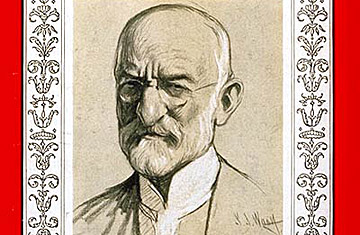
Heber Jedediah Grant, seventh president of The Church of Jesus Christ of Latter-day Saints
(See front cover)
In the State of Utah the rock of ages has assumed strange forms. Geologically, as observed in such scenic reservations as Bryce Canyon National Park, The Cedar Breaks, Zion National Park (see map p. 27), the rock has been sculptured by erosion, forming unearthly peaks and terraces, ornate gorges, petrified and ghostly cities. Utah's religious rock of ages—its dominant church—is equally exotic. It is, as everyone knows, the Church of Jesus Christ of Latter-day Saints, or, more familiarly, the Mormon Church. Fully half of Utah's half-million souls are Mormons. The history and commercial development of Utah is more closely linked with the Mormon Church than is Roman history with Catholicism.
Last week the thoughts of all the 700,000 Mormons in the world dwelt in Salt Lake City, capital of Mormondom and of Utah, where the centenary of the founding of the Church was to be celebrated, exactly to the day, on April 6, 1930. A week of exercises and formal rejoicing was scheduled to follow.
Holy rites of celebration would be secretly performed in the six-spired Mormon Temple, open only to Mormon church-members in good standing (i.e., approved as moral and right-minded by their local pastors—'"bishops"), and thus long supposed by superstitious Gentiles* to conceal queer ceremonies of polygamous import. But Mormonism is by no means merely a closeted, holy matter. It is also a hard-headed economic system and the communicants are bustling, practical, prosperous. Always have non-Mormons been welcomed to services and organ recitals in the great domed Tabernacle (seating capacity 10,000) just behind the Temple. This auditorium, where the late great Soprano Adelina Patti remarked: "My voice is twice as large here," had undergone last week a vast refurbishing for a public pageant calculated to impress its audiences with the fact that Mormonism is a successful religion if ever there was one. Accompanying the pageant would be music from one of Mormondom's most cherished treasures— its mighty organ. In 1866 oxen began hauling the logs which formed its 32-foot diapason, its tiny flutinos. Glue was made by boiling strips of cattle and buffalo hides. Recently reconstructed, the instrument, with 5,500 pipes, is among the world's largest, draws comparisons with those in Frieburg, London's Crystal Palace, Manhattan's St. Patrick's Cathedral. Designed on a monumental, historic scale, the pageant would begin, of course, in Heaven, where the Creator's appointment of Jesus as a Redeemer was to be represented with luminous effects and invisible voices. Next would be shown the creation of the world and its peoples; the ancient prophets; the Nativity, Sermon on the Mount, Resurrection. Then would follow the dark period of apostasy and, finally, the story of Mormonism: