

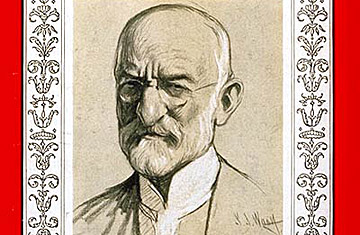
Heber Jedediah Grant, seventh president of The Church of Jesus Christ of Latter-day Saints
(2 of 4)
In September, 1823, Joseph Smith, son of a New York farmer, claimed that he had talked with a radiant nocturnal visitor who caused him to be led, by divine guidance, to a lonely hill near the village of Manchester, N. Y., where he discovered numerous engraved and lettered plates of gold in a cachet of stone. Annually for four years he returned to look at the plates; then they were delivered to him by his spectral visitor. In 1830 there was first published The Book of Mormon, purporting to be a translation of the plates accomplished with divinely acquired erudition by humble Joseph Smith, 25. That year the Mormon Church, based upon the revelations of this book, was established in a farmhouse in Fayette, N. Y., and Joseph Smith became its first Prophet. Soon the golden plates were nowhere to be found. Prophet Smith averred that he had returned them to the heavenly messenger. Mormon curiosity still contents itself with a sworn statement by numerous early Mormon dignitaries which declares:". . . We have seen and hefted . . . the plates."
The Book of Mormon (522 pages in a recent edition) contains the history of ancient peoples (among them the Lamanites), who supposedly inhabited the Western Hemisphere, coming variously from the Tower of Babel and Jerusalem. They had apostles and prophets even as the Biblical peoples. One of these was called Mormon. To them Christ appeared. He ordained that, after the age of apostasy, his true church should be reestablished somewhere in the Americas. That re-establishment was what took place in 1830 in the Fayette farmhouse. At that time considerable numbers of the ancient Lamanites were still alive. They were customarily referred to as Indians.
The new Church soon established branches in New York, Pennsylvania, Ohio, Indiana, Illinois, Missouri. Prophet Smith decreed that Mormons were properly polygamous and took unto himself several comely wives. This practice, sturdily maintained, was among those which brought general persecution on the Church. In 1842 Prophet Smith became a martyr to his 'faith. He had been arraigned 39 times on various charges without once being convicted. At length he was charged with treason against the State of Illinois, was jailed at Carthage. A mob attacked the prison; both Prophet Smith and his brother Hyrum were shot dead. In 1847, harassed beyond endurance by their enemies in the East, the greater part of the Mormon Church followed its new leader, Prophet Brigham Young, to the empty land of Deseret which has become thriving, bountiful Utah, a Mormon achievement.
Mormon good fortune since the trek to Utah is due in no small measure to a faith which greatly admires and encourages prosperity. Mormons irrigated, planted and built with as much persistence as they prayed. A striking fact is that the Mormons did not dig in the ground 'for metallic wealth but concentrated on husbandry. They made a desert bloom. A good Mormon, and the "good" percentage is extraordinarily large, abstains from tea, coffee, tobacco, liquor. He pays a tithe (one-tenth) of his entire income to the Church. He hearkens to the Mormon proverb "the glory of God is intelligence." Thus does the Church seek health, wealth and wisdom.
Mormon health is proverbial; Utah's birth rate is generally higher, its death rate lower, its infantile sickness less than in any other State in the U. S.