

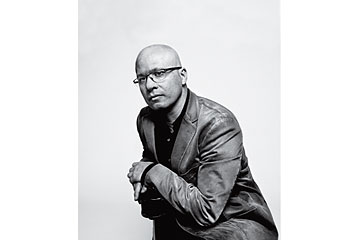
Alexander Hemon
(2 of 3)
Hemon did a little of both. The year before the siege of Sarajevo, he escaped to his family's mountain cabin with only a radio and stacks of books to read "before the war consigned everything and all to death and oblivion," as he later wrote in Granta. With only jazz, wood chopping and the family dog as distractions, he experienced "a kind of hypersensitive exaltation that allowed me to average four hundred pages a day," he writes in The Book of My Lives. "The book would become a vast, intricate space in my head, and I couldn't leave it, not when I ate, not when I hiked, not when I slept--I lived inside it."
It took a propaganda unit to break him out of this space. The now defunct U.S. Information Agency invited the young Bosnian writer on a monthlong tour of America, where he learned enough English to get by. "I was supposed to fly back from Chicago on May 1, 1992," he says. "It would have put me in Sarajevo on May 2." On that day, Bosnian Serb forces completed the total blockade of Sarajevo.
His parents fled the city for his grandparents' rural house; they eventually emigrated to Canada, where his father, a former engineer, found work at a steel mill, and his mother, a former accountant, became a building superintendent. Hemon, then 27, was stranded in Chicago. (He wouldn't return to Bosnia for five years.) With his money and prospects quickly dwindling, he found an expat community, scrounged for work and bounced around a series of abject apartments, all while navigating the space between immigration and integration.
"I busied myself comparing how you Americans do things to how my friends and parents did," he says. "And then I had a revelation: Miles Davis was American--not in the sense of patriotism but that he re-created the ultimate American music idiom. I had been arguing with abstractions, with collective and individual essences. But someone like Miles could never be reduced to that. He was sovereign."
Hemon decided that instead of just consuming culture, he would create it. His memories, struggles and encounters became stories in English. By decade's end, he'd generated enough to compile The Question of Bruno, which introduced Hemon's bumbling quasi-doppelgänger, the Bosnian refugee Jozef Pronek. Pronek's adventures continued in 2002's dazzling hall-of-mirrors novel Nowhere Man, which begins as the coming-of-age story of a Bosnian immigrant in Chicago and ends up something else entirely, told in a virtuosic polyphony and ranging over Harbin, China; Shanghai; Sarajevo; Kiev, Ukraine; and Chicago.
The Lazarus Project focused on another immigrant in contemporary Chicago, Vladimir Brik, who becomes obsessed with the true-life story of Lazarus Averbuch, who was shot to death in 1908 at the home of the Chicago chief of police. As Brik's and Averbuch's destinies intertwine, the book's pages turn up images of Averbuch alongside photographs by Hemon's lifelong friend, the Montreal-based photographer Velibor Bozovic. It's perhaps implied that Bozovic's black-and-white images, taken across Eastern Europe, are meant to represent Brik's point of view: eerie, untethered, uncaptioned, maybe untrustworthy.