

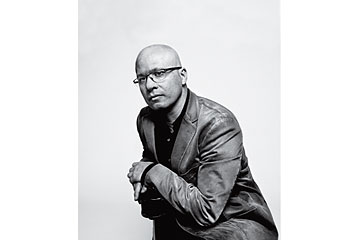
Alexander Hemon
The true story of Aleksandar Hemon begins in a country that no longer exists.
It's an ancient story: a young man examines his surroundings (in this case, late-1980s Yugoslavia), discovers influences (Conan the Barbarian, Sonic Youth, John le Carré, the Old Testament, Tolstoy), finds his voice (by writing stories, poems and essays about his hometown of Sarajevo) and leaves home.
It's also a horror story of political turmoil, warfare and exile and, later, the loss of an infant daughter. As recounted in Hemon's new memoir, The Book of My Lives, it's at once unimaginable and unforgettable. And it ends--if the life story of a 48-year-old man safely ensconced in Chicago at the peak of his creative powers can be said to have ended--in a flurry of international acclaim. Hemon has published two story collections (2000's The Question of Bruno and 2009's Love and Obstacles), a novel (2002's Nowhere Man) and a spellbinding, sort-of fictional sort-of biography (2008's The Lazarus Project), along the way picking up a Guggenheim fellowship, a MacArthur "genius" grant and many other honors. With Hemon, says the writer Jonathan Lethem, "above all and no matter the topic or register, it's the voice--that glowering intelligence pulsing behind a truly glittering surface."
All along, he has told stories that cross--and erase and evade--the borders between fact and fiction. He tells complicated stories in complicated ways, because the world is complicated. Even his memoir is most devastatingly true when it asserts the vitality and succor of invention. Sometimes one has to make things up to make sense of it all. Hemon has mastered this.
"He's the only Eastern European writer I know for whom the Conrad comparisons make sense," says the novelist Gary Shteyngart. "His ability to inhabit both worlds, Bosnia and the Midwest, requires a different kind of brain."
Like Joseph Conrad before him, Hemon writes in a language he learned as an adult; it has been 20 years since he wrote his first story in English. Growing up in Sarajevo, he watched the socialist dream descend into fascism with the rise of Serbian President Slobodan Milosevic. As an ambitious young punk who played in rock bands and wrote for the local alternative paper, Hemon began deejaying at a radio station. "I sent signals by playing songs," he says with a laugh over a shrimp po' boy, rice and beans at an ersatz-Southern restaurant in Chicago on a snowy day in early March. "I'd put on the MC5's 'Kick Out the Jams,' trying to stoke a revolution."
He didn't. "Almost all the people I knew, even some of my friends, easily converted to fascism," he says. "Culture is not necessarily ennobling. You can formulate your ethics by engaging with culture, but you can also find your ethics by staring at the f---ing wall."