

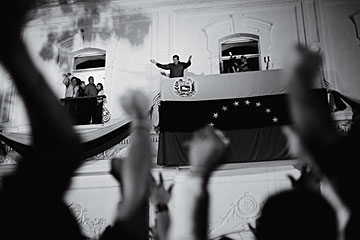
Chévez greets his supporters on the balcony of his palace after winning re-election in 2006
(2 of 2)
The putsch, which killed scores of civilians as well as soldiers, collapsed after Chávez failed to take the Miraflores presidential palace in Caracas. Still, the insurrection was cheered by millions of angry Venezuelans, half of whom lived in poverty, and by millions more across Latin America who'd been left behind by the region's capitalist reforms. The next year Pérez was ousted on corruption charges; in 1994, popular clamor forced President Rafael Caldera to release Chávez from prison. The cashiered officer decided to take power via ballots instead of bullets, and four years later he won the presidency with nearly 57% of the vote.
La Republica Bolivariana
Inaugurated in 1999, Chávez rewrote Venezuela's constitution to make what he called its "sham" democracy more "participatory." Under the new charter he won a special presidential election in 2000 that gave him a fresh six-year term. He began jetting all over the world to forge ties with leaders who, like him, disdained Washington — and, more important, to get fellow members of the Organization of Petroleum-Exporting Countries (OPEC) to pump up oil prices. The success of that campaign took the Bush Administration by surprise and increased the annual revenue of Venezuela's state-run oil monopoly, Petróleos de Venezuela (PDVSA), from less than $25.8 billion in 1998 to more than $126 billion when oil prices peaked in 2008.
But despite Chávez's democratic credentials and his misiones — vast social projects that brought many barrios their first clinics, schools, decent housing, local councils and even drinkable water — participatory democracy increasingly meant concentrating power in the hands of el comandante. His subordination of the legislative and judicial branches, his politicization of PDVSA and his frequent, hours-long television rants so divided Venezuela that in April 2002 Chávez himself became the target of a coup. For two days he was ousted from office, but Chávez's supporters poured out of Caracas' slums to restore him to power. The event hardened his socialist leanings and his hatred of the Bush Administration, which despite its denials was widely believed to have backed the coup.
That debacle was typical of Chávez's incompetent opposition, as was its failed attempt to oust him in a 2004 recall referendum. By then, oil prices were in dizzying ascent, and Chávez's social spending at home and his petrodiplomacy abroad were lavish. A wave of leftist Presidents were elected across Latin America, including Lula in 2002 and Bolivia's Evo Morales in 2005. Chávez was their standard bearer. His big aim, as he told me in 2006, was to replace the two-centuries-old Monroe Doctrine of the U.S. with his Bolívar Doctrine. It would be a "counterbalance" to U.S. hemispheric hegemony, he said, "a doctrine of more equality and autonomy among nations, more equilibrium of power." And to a surprising extent, he and Latin America realized that goal.
As Chávez's petro power swelled, so did his head and his mission to be a global subversive. He began to overreach. If his verbal assault on Bush at the U.N. won him kudos in some quarters, it cost him standing in many others, especially as he allied Venezuela with international pariahs like Iran and Syria. Lula, who won re-election in 2006, was now Latin America's standard bearer, and Chávez's star began to dim. In 2007 he held a constitutional referendum whose central question was whether to eliminate presidential term limits; Venezuelan voters, fatigued by permanent revolution, defeated it. Chávez simply forced another plebiscite on the issue little more than a year later and won — el comandante rarely took no for an answer — but in the process he made himself look more like the despotic Castro.
As the global recession sent oil prices tumbling, Chávez's failure to rein in a raft of crises — including deep corruption inside his own revolution — began to stand out. So did declining investment and production at PDVSA. With Barack Obama in the White House instead of Bush, Chávez no longer had a convenient yanqui villain to help him distract Venezuelans from those domestic problems. As a result, the opposition began making inroads. Then, in June 2011, Cuban doctors found and removed a tumor near Chávez's pelvis. Eight months later the cancer returned, and pundits questioned how Chávez could carry on a re-election campaign in 2012, especially now that the opposition finally had a viable candidate in Capriles to challenge him. After more treatment, Chávez went on to rout Capriles. Yet two months later he was back on an operating table in Cuba, where he could keep his true condition a more tightly guarded secret. The world would never hear from him again.
What Chávez couldn't hide toward the end was the fact that his revolution was effectively a one-caudillo show, as evidenced by the awkward government indecision back in Caracas during his long absences in Havana. Add the fact that Chávez's 2012 victory margin was almost 10 points lower than it was in 2006, and it becomes clear that Maduro could face serious challenges in the upcoming special election.
If Maduro wins — as he's expected to do — the question will remain: Will Venezuela continue to be America's most strident antagonist in the Americas, or it will seek the more "constructive relationship" Obama called for after Chávez's death? One hint: hours before Chávez died, Maduro accused two U.S. embassy officials of being spies and ordered their expulsion.
Even if Maduro loses, Washington and the rest of the world need to remember the unmistakable reasons for Chávez's rise to power — chief among them a failure to build the kind of democratic institutions in Latin America that can close the region's unconscionable wealth gap. That flaw still lingers, which is why the memory of Chávez will too.