

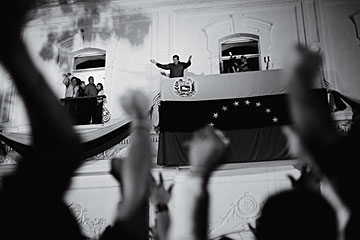
Chévez greets his supporters on the balcony of his palace after winning re-election in 2006
Like his idol, Fidel Castro, Venezuelan President Hugo Chávez was one of the most garrulous and pugnacious leaders Latin America has ever known. That made his death in Caracas on March 5, at age 58, after a long and secrecy-shrouded fight with cancer, feel all the more incongruous. Chávez, who for all of his 14-year rule was as loud and ubiquitous a fixture in Venezuela and Latin America as salsa music on the sidewalks, departed the stage in silence, having been neither seen nor heard from publicly for three months.
But Chávez's demise promises to trigger a constitutional upheaval inside Venezuela, where he and his socialist, anti-U.S. revolution controlled the world's largest oil reserves and where an electorate bitterly polarized by his heavy-handed governance must now hold a new presidential election within the next month. That contest will likely pit Chávez's less charismatic but ideologically ardent Vice President, Nicolás Maduro, against Miranda state Governor Henrique Capriles Radonski, the popular opposition leader whom an ill Chávez nonetheless handily defeated in October to win re-election.
Whoever the candidates are, the race will be a decisive test of whether chavismo — the left-wing ideology advanced by Chávez — can survive without the man it's named for. Maduro, 50, a former bus driver whom el comandante publicly anointed as his successor before leaving for Cuba and his final round of cancer treatment in December, will be considered the favorite. Still, without the benefit of Chávez's quasi-divine stature on the Venezuelan street, Maduro will have a tougher time dodging the economic and public-security crises that Chávez left behind. And that's why one of the most hotly debated issues is sure to be Chávez himself and his frenetic legacy — whether his firebrand reign ultimately represented an advance or a setback for the Latin American left.
Chávez liked to call himself a "21st century socialist." In reality he was a throwback to the dogmatic and authoritarian 20th century socialism of Castro — and to the 19th century caudillo tradition of Chávez's demigod, South American independence hero Simón Bolívar. Chávez hoped that being democratically elected repeatedly would obscure the fact that he didn't govern all that democratically. It didn't. So it's tempting to dismiss him as an anachronism, a vulgar populist famous for yanqui bashing — calling U.S. President George W. Bush a malodorous "devil" during a notorious 2006 speech at the U.N. — and an erratic messianic retro-revolutionary whose country's vast petrowealth bankrolled his Marxist nostalgia.
Chávez was all those things. But if he was a leader behind his times, he still managed to influence them. Voters don't make a radical like Chávez their head of state unless they're mad as hell, and his stunning ascent altered Latin America's conversation when it needed to be altered. When Chávez was first elected, in 1998, post — Cold War Latin America was awash in free-market reforms. Those changes were necessary, but their negligent implementation only widened the region's crippling economic inequality. Chávez's bellicose neostatism was hardly the antidote, but his Bolivarian revolution — which steered much of Venezuela's oil riches to the barrios for a change and enfranchised its poor — was a wake-up call. It reopened the door for the Latin American left and, fortunately, more moderates than Marxists walked through it, including former Brazilian President Luiz Inácio Lula da Silva, whose capitalist-socialist "third way" has since helped narrow the region's wealth gap and brought troubled countries like Chile to the brink of development.
Leftists like Lula, in fact, are the genuine 21st century socialists, and their rise eroded Chávez's influence well before his cancer was diagnosed in the summer of 2011. Ironically, that decline can be traced back to September 2006, when oil prices were soaring and Chávez was at the height of his power and popularity at home and across the developing world. He could taunt Bush at the U.N. and hear applause from Caracas to Karachi, yet in a TIME interview in New York City the day after that speech, he forecast how his global relevance would wither from then on. Chávez told me, with his famously caffeinated conviction, that he now planned to turn even harder leftward. "I no longer think a third way [between socialism and capitalism] is possible," he said. "Capitalism is the way of the devil and exploitation. Only socialism can create a genuine society."
After winning another six-year term by a landslide three months later, Chávez did turn further left, and his pursuit of ideological purity led to creeping authoritarianism and a mismanaged economy. Chávez was never the dictator his critics claimed, and he did reduce Venezuela's high poverty rate. That helped him remain the nation's most popular political figure — he beat Capriles by 11 points last fall — even as cancer checked his campaigning. Still, thanks to his reckless and arrogant impulses, history isn't likely to remember Chávez as fondly as his followers will.
From the Plains to the Putsch
Born in rural Sabaneta, Venezuela, in west-central Barinas state, Chávez grew up poor on the llanos, or plains, raised largely by a grandmother instead of his parents, who were teachers. In Barinas he absorbed the sort of nationalist Marxism that got a boost in 1959 from Castro's revolution in Cuba. Chávez learned to demonize the imperialist U.S. of that era and to deify the Caracas-born Bolívar. He exalted the llaneros, the defiant plains cowboys embodied by his great-grandfather, who had led a revolt against an early 20th century dictator.
Once in the army — where he eventually became a paratrooper lieutenant colonel — his Bolivarian self-image and his resentment of Venezuela's venal, Washington-backed upper crust helped form an officer poised for rebellion. On Feb. 4, 1992, Chávez directed a coup against President Carlos Andrés Pérez, a cogollo, or chieftain, notorious for corruption scandals even as he imposed austerity measures on Venezuela's working class.