

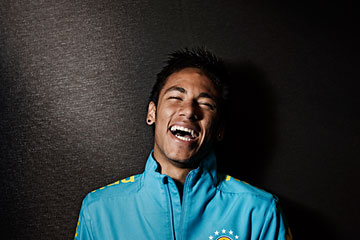
Neymar earns enough at Santos to decline lucrative overseas offers
(3 of 4)
The Prodigal's Return
Until the economic boom, the traditional arc of a Brazilian superstar's career ran thus: at 14, his talent was spotted by a local club; four years later, he was traded up to one of the smaller European leagues, like Portugal's, where his prodigious performances marked him as the Next Pelé; he had a couple of good seasons before a superclub like Real Madrid, AC Milan or Manchester United came calling. At Neymar's age, he was a full-blown global celebrity, with flashy cars, model girlfriends and big endorsement deals. If he had the right temperament — and durable knees — he could stay at the top of the European tree until his early 30s. Slowed by age, he then moved on to second-tier leagues, like Russia's or Turkey's, where he could still pull down a million-dollar salary; by 35, he was squeezing out the last few paydays playing in Qatar or Japan.
The pattern started to change in the late 2000s, when better-run, better-financed Brazilian clubs began to poach expatriate players in the Spanish and Italian leagues who might otherwise be heading east. In 2009, Corinthians snagged Ronaldo, star of the 1998 and 2002 World Cups, from AC Milan. To pay his salary, the club allowed advertising on its shirtsleeves for the first time — and gave Ronaldo the proceeds. "It was a risk, because we'd never sold that space before," says Corinthians vice president Luis Paulo Rosenberg. "But the marketing rewards were worth it."
Although slowed by multiple injuries and conspicuously overweight (some São Paulo restaurants named their fattiest steaks after him), Ronaldo was good value, scoring 29 goals in 52 league matches over two years. His star power was a boost for Corinthians at home and abroad. "People who had never heard of us, in Thailand and Vietnam ... they knew us now because we had Ronaldo," says Rosenberg. Corinthians' fortunes have not looked back since: it won the Copa Libertadores in 2012, before beating Chelsea in the final of the Club World Cup in December.
Ronaldo's remunerative return paved the way for other prodigals, among them Ronaldinho Gaúcho from Milan, Luís Fabiano from Seville, Fred from Lyon, Juninho Pernambucano from Qatar, Deco from Chelsea and Jô from Manchester City. Many were already past their prime, but not all. Alexandre Pato, who moved from Milan to Corinthians in December, is only 23 and one of the world's top strikers.
They are going home to a new kind of football organization. "The infrastructure is much better than it used to be, the training grounds, the medical staff, the support staff," says Deco, who left Brazil as a callow 19-year-old in 1997 to play first in Portugal (where he became a citizen, as have Brazilian players in other nations), then Spain and England before returning to lead Fluminense to the 2012 Brazilian Championship.
It helps that the clubs are now able to recruit professional administrators. Rio de Janeiro corporate lawyer Elena Landau, a former director of privatization at Brazil's national development bank, recalls the struggle to hire business managers at her favorite club, Botafogo, in 2003. "We were calling friends who had retired from corporate jobs and pleading with them to come and help run the club," she says. "Now, you can hire smart young people with sports-management degrees from university."
As a result, clubs like Corinthians have developed sophisticated marketing and brand-management strategies, the better to capitalize on their giant fan base at home and tap markets abroad. "They're thinking like European clubs now," says Washington Olivetto, chairman of the advertising firm WMcCann and well-known Corinthians fan. "They're beginning to understand how much their brand is worth." Club vice president Rosenberg points to the club's 115 franchise shops in Brazil as an innovation for Brazilian football and talks about a long-term strategy to develop the Corinthians brand in China. The club sent two coaches to Guangdong province, to help train coaches there, and took a Chinese player, Chen Zhizhao (promptly dubbed Zizao by Brazilian fans) to São Paulo. "The Chinese response has been fantastic," Rosenberg says.