

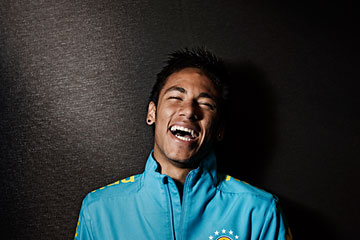
Neymar earns enough at Santos to decline lucrative overseas offers
(2 of 4)
In 2012, his most prolific year yet, Neymar scored 52 goals in 58 games, including nine in 11 for the Brazilian national team. Those stats didn't escape the attention of European soccer powerhouses like Barcelona and Real Madrid, which head a long queue of clubs seeking to take Neymar away from Brazil.
Neymar has politely turned down all advances. This is highly unusual for a player of his talent and age: he turned 21 on Feb. 5. He could easily be making tens of millions of dollars at Real Madrid or Manchester United. But he insists he's not going anywhere, at least until 2014, when his current contract with Santos expires. Neymar tells me he's perfectly content to remain in his working-class hometown on the Atlantic Coast. "I always do what my heart tells me," he says. "For me, the right time has not come to leave Brazil. I am very happy." For his part, Santos' president, Luis Álvaro de Oliveira Ribeiro, says he defines his job as "making sure Neymar has no reason to go." That means paying his star a world-class wage, allowing him to make separate deals with sponsors and giving him time off for his endorsement commitments. None of this would be possible without Brazil's economic success.
To São Paulo economist Ricardo C. Amorim, Neymar symbolizes the newfound ability of emerging economies to fight the brain drain, usually to the West, of their best and brightest. A strong Indian economy, he points out, is better able to retain its best engineers from heading to the U.S. and even lure some back. Brazil's gravitational pull is likewise growing stronger. In the past decade, more than 30 million people rose from poverty into what Brazilian economists call Class C, defined as those with a monthly income of $140 to $500. That's 30 million more people who can now afford to pay more for soccer tickets, buy club merchandise, watch games on cable, buy Adidas cleats and Nike shirts.
There's Gold in the Goals
As a result, the combined revenues of Brazil's top 100 club teams grew from $396 million in 2003 to $1.4 billion in 2011, according to research compiled by sports consultant Amir Somoggi; revenues for 2012 are expected to top $1.35 billion. The top 10 teams account for 65% of the pie, giving them a windfall not unlike the country's discovery of huge offshore oil reserves. Santos' revenue soared 548% to $105.2 million between 2003 and 2012; at Corinthians, the league's top earner, it grew 481% to $157.3 million. Much of this growth is due to better TV deals, new sponsors and merchandising.
For too long soccer was a cesspool of corruption in Brazil. The teams, technically not-for-profit organizations, borrowed huge, had notoriously opaque bookkeeping and sold players to stay solvent. Unscrupulous agents also peddled Brazil's soccer players like they would its cattle, shipping them to all corners of the world — and letting them fend for themselves if things didn't work out. The former head of its football federation, Ricardo Teixeira, stepped down last year amid allegations that he and his predecessor (and father-in-law) João Havelange received millions of dollars in bribes for World Cup marketing rights.
It's hard to imagine now that the Brazilian government in 1961 had to declare Pelé a national treasure to prevent European clubs from absconding with him in his prime. The Next Pelé needs no legislation to hold him: he can earn European wages without leaving home. France Football magazine listed Neymar as the 13th-highest-paid player in 2012, with annual earnings of $18.26 million. About half came from endorsements and commercial deals. Although the total trailed Messi's $44 million, it still made Neymar the second-highest-paid Brazilian: Kaká, playing occasionally (and unhappily) for Real Madrid, made $20.5 million. And at 30, Kaká's best years are likely behind him.
Neymar insists his income has no bearing on his druthers to remain at Santos, saying: "I think my decision would have been the same 15 years ago." But even assuming he'd have settled for a fraction of his current wage, it would not have been his call. If the club's revenue was at the level of preboom Brazil — $19.19 million in 2003 — Ribeiro, the president, could hardly have resisted a $65 million offer for Neymar from, say, Chelsea.
Instead, Ribeiro can now dream of building on Santos' newfound riches: he hopes to move the club out of the Vila Belmiro, a quaint, century-old stadium that can accommodate 17,000, to an arena three times its capacity on the outskirts of town. He also made an audacious bid to bring back one of Santos' prodigal sons, Robinho, from AC Milan: that deal could be concluded in the middle of the year. "This is a great time for Brazilian football," Ribeiro says. "It is reinvigorating its self-esteem by showing that we are no longer just exporters of players."