

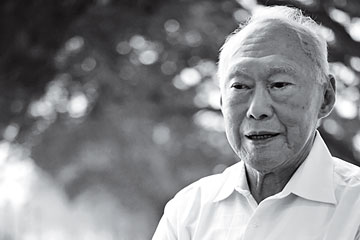
The sage of Singapore Lee's steely micromanagement of the Lion City brought out some of the worst in him; his geopolitical thought--incisive, prescient and at times brilliantly framed--some of the best
Lee Kuan Yew hails from a very small country, but, for decades, he has been a very big man — at home and on the world stage. During more than a half-century of public life, including some 30 years as Prime Minister, Lee transformed Singapore from a simple trader of commodities into a sophisticated hub of finance and technology — The Little Red Dot, as many of its people affectionately call it.
A stern, patriarchal figure, Lee realized his ambitions for Singapore through the sheer force of his personality, buttressed by an unapologetic conviction that he knew best. The same qualities that influenced his finer policies affected his worse ones too. Single-mindedness, for example, could become heavy-handedness. The stain on Lee's standing is that, in the controlled experiment of molding a society in his own severe image, he marginalized social liberties both sacred and mundane: from expressing dissent to chewing gum.
That dark side will undoubtedly color Lee's legacy. Yet he has always had too much vision to be limited to tiny Singapore, or to be your run-of-the-mill strongman. Lee possesses an ability to interpret the past, understand the present and divine the future. The more enduring, and endearing, part of him is the globalist long sought out by national leaders and corporate titans for his counsel on the way of the world.
Lee's powerful intellect is captured in a new book, Lee Kuan Yew: The Grand Master's Insights on China, the United States, and the World. It's a collection of interviews with him by Harvard University professor Graham Allison, Council on Foreign Relations senior fellow Robert Blackwill and Harvard's Belfer Center researcher Ali Wyne, while also drawing on other selected and cited writings by and about Lee. Now 89, officially retired and somewhat frail, Lee has mellowed with age — not unlike his creation Singapore, governed today with a lighter touch even as its citizens grow more vocal. Yet, as the book, and the adaptation here of the China chapter, reveal, Lee is as sharp, direct and prescient as ever. Though the volume was completed before China's current territorial tensions with its neighbors, it helps expose, and explain, Beijing's hardball mind-set.
Over the years Lee has been called many things — unflattering as well as admiring. But perhaps the single most fitting description is: The Man Who Saw Tomorrow.
Are Chinese leaders serious about displacing the U.S. as the No. 1 power in Asia and, eventually, the world?
Of course. They have transformed a poor society by an economic miracle to become now the second largest economy in the world — on track to become the world's largest economy. They have followed the American lead in putting people in space and shooting down satellites with missiles. Theirs is a culture 4,000 years old, with 1.3 billion people, with a huge and very talented pool to draw from. How could they not aspire to be No. 1 in Asia, and in time the world? The Chinese people have raised their expectations and aspirations. Every Chinese wants a strong and rich China, a nation as prosperous, advanced and technologically competent as America, Europe and Japan. This reawakened sense of destiny is an overpowering force. The Chinese will want to share this century as co-equals with the U.S.
How will China's behavior toward other countries change if China becomes the dominant Asian power?
At the core of their mind-set is their world before colonization and the exploitation and humiliation that brought. In Chinese, China means Middle Kingdom, recalling a world in which they were dominant in the region, when other states related to them as supplicants to a superior and vassals came to Beijing bearing tribute. Will an industrialized and strong China be as benign to Southeast Asia as the U.S. has been since 1945? Singapore is not sure. Neither is Brunei, Indonesia, Malaysia, the Philippines, Thailand or Vietnam. We already see a China more self-assured and willing to take tough positions. The concern of America is what kind of world they will face when China is able to contest their pre-eminence. Many medium and small countries in Asia are also concerned. They are uneasy that China may want to resume the imperial status it had in earlier centuries and have misgivings about being treated as vassal states having to send tribute to China as they used to in past centuries. [The Chinese] tell us that countries big or small are equal; [that they] are not a hegemon. But when we do something they do not like, they say you have made 1.3 billion people unhappy. So please know your place.
What is China's strategy for becoming
No. 1?
The Chinese have concluded that their best strategy is to build a strong and prosperous future, and use their huge and increasingly highly skilled and educated workers to outsell and outbuild all others. The Chinese have calculated that they need 30 to 40 — maybe 50 — years of peace and quiet to catch up, build up their system, and change it from the communist system to the market system. They must avoid the mistakes made by Germany and Japan. Their competition for power, influence and resources led in the last century to two terrible wars. The Russian mistake was that they put so much into military expenditure and so little into civilian technology that their economy collapsed. I believe the Chinese leadership has learned that if you compete with America in armaments, you will lose. You will bankrupt yourself. So, keep your head down, and smile for 40 or 50 years.