

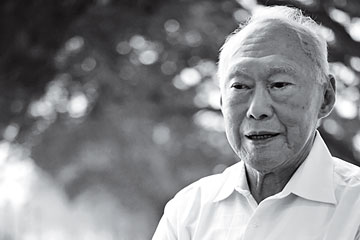
The sage of Singapore Lee's steely micromanagement of the Lion City brought out some of the worst in him; his geopolitical thought--incisive, prescient and at times brilliantly framed--some of the best
(2 of 2)
What are the major hurdles in executing that strategy?
There will be enormous stresses because of the size of the country and the intractable nature of the problems: the poor infrastructure, the weak institutions, the wrong systems that they have installed. Straight-line extrapolations from [China's] remarkable record are not realistic. China has more handicaps going forward and more obstacles to overcome than most observers recognize. Chief among these are their problems of governance: the absence of the rule of law, which in today's China is closer to the rule of the emperor; a huge country in which little emperors across a vast expanse exercise great local influence; cultural habits that limit imagination and creativity, rewarding conformity; a language that is exceedingly difficult for foreigners to learn sufficiently to embrace China and be embraced by its society; and severe constraints on its ability to attract and assimilate talent from other [countries].
China will inevitably catch up to the U.S. in absolute GDP. But its creativity may never match America's because its culture does not permit a free exchange and contest of ideas. How else to explain how a country with four times as many people as America — and presumably four times as many talented people — does not come up with technological breakthroughs?
Technology is going to make their system of governance obsolete. By 2030, 70% or maybe 75% of their people will be in cities, small towns, big towns, megabig towns. They are going to have cell phones, Internet, satellite TV. They are going to be well informed; they can organize themselves. You cannot govern them the way you are governing them now where you just placate and monitor a few people because the numbers will be so large.
How do China's leaders see the U.S. role in Asia changing as China becomes No. 1?
The leadership recognizes that as the leading power in the region for the seven decades since World War II, the U.S. has provided a stability that allowed unprecedented growth for many nations including Japan, the Asian tigers and China itself. China knows that it needs access to U.S. markets, U.S. technology, opportunities for Chinese students to study in the U.S. and to bring back to China new ideas about new frontiers. It therefore sees no profit in confronting the U.S. in the next 20 to 30 years in a way that could jeopardize these benefits. Rather, its strategy is to grow within this framework, biding its time until it becomes strong enough to successfully redefine this political and economic order.
What impact is China's rise having on its neighbors in Asia?
China's strategy for Southeast Asia is fairly simple: China tells the region, "Come grow with me." At the same time, China's leaders want to convey the impression that China's rise is inevitable and that countries will need to decide if they want to be China's friend or foe. China is also willing to calibrate its engagement to get what it wants or express its displeasure.
Will China become a democracy?
No, China is not going to become a liberal democracy; if it did, it would collapse. Of that I am quite sure, and the Chinese intelligentsia also understands that. If you believe that there is going to be a revolution of some sort in China for democracy, you are wrong. Where are the students of Tiananmen now? They are irrelevant. The Chinese people want a revived China. Can it be a parliamentary democracy? This is a possibility in the villages and small towns. The Chinese fear chaos and will always err on the side of caution. It will be a long evolutionary process, but it is possible to contemplate such changes. Transportation and communications have become so much faster and cheaper. The Chinese people will be exposed to other systems and cultures and know other societies through travel, through the Internet and through smart phones. One thing is for sure: the present system will not remain unchanged for the next 50 years. To achieve the modernization of China, her communist leaders are prepared to try every method, except for democracy with one person and one vote in a multiparty system. Their two main reasons are their belief that the Communist Party of China must have a monopoly on power to ensure stability and their deep fear of instability in a multiparty free-for-all, which would lead to a loss of control by the center over the provinces. To ask China to become a democracy, when in its 5,000 years of recorded history it never counted heads — all rulers ruled by right of being the emperor; if you disagree, you chop off heads, not count heads.
How should one assess new Communist Party chief Xi Jinping?
He has had a tougher life than [his predecessor] Hu Jintao. His father was rusticated, and so was he. He took it in stride, and worked his way up. It has not been smooth sailing for him. His life experiences must have hardened him. He is reserved — not in the sense that he will not talk to you, but in the sense that he will not betray his likes and dislikes. There is always a pleasant smile on his face, whether or not you have said something that annoyed him. He has iron in his soul, more than Hu Jintao, who ascended the ranks without experiencing the trials and tribulations that Xi endured. He is a person with enormous emotional stability who does not allow his personal misfortunes or sufferings to affect his judgment. He is impressive.
Adapted from Lee Kuan Yew: The Grand Master's Insights on China, the United States, and the World. Interviews and selections by Graham Allison and Robert D. Blackwill, with Ali Wyne. To be published by The MIT Press, February 2013. © 2013 Belfer Center for Science and International Affairs. All rights reserved.