

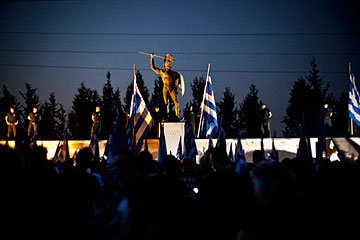
"Blood! Honor! Golden Dawn!" Hundreds of the "new Spartans" rally around a statue of Leonidas, hero of the Battle of Thermopylae.
(3 of 3)
Boukouras is wiry and energetic and has the gait of a street fighter. He rarely dresses up, favoring the black T-shirt and fatigues worn by Golden Dawn diehards. He likes visiting the local hospital, which he says is badly run because of corrupt politicians and austerity wreaked by "the occupiers' memorandum," referring to the terms of the bailout-loan agreement by the country's troika of lenders: the E.U., the European Central Bank and the International Monetary Fund. During a visit to the hospital in August, Boukouras gave blood that he wanted to be designated for Greeks only (the hospital refused) and glared at an Albanian teenager who wanted to see a doctor for stomach pains. "Why is he here, milking free health care for Greeks?" Boukouras said loudly. Then Sotiria Christodoulou, 56, who was there for a checkup, spotted Boukouras. "My boy, you're here looking out for us!" Christodoulou cooed, trying to kiss Boukouras' hand. "The media only report lies about Golden Dawn," she said, turning to me. "They are nice family men. They don't hurt anyone." Boukouras grinned.
Later, as he ate souvlaki on his terrace with his wife, he showed me photos on his digital camera from a summer camp where Golden Dawn members learned "survival techniques," often with weapons. The party anthem, a martial ode to Hellenism, is the ringtone on his phone. It rang often, usually with people who want money or jobs or someone to "sweep" immigrants out of a neighborhood. On the last count, Boukouras is happy to oblige. "Until 2002, I employed Pakistanis at my bakery in Athens," he says. "I hadn't realized then the terrible things these people who enter illegally do to my country ... I fired them, and now I only hire Greeks."
Boukouras says he's never physically attacked an immigrant, but he blames them for a rise in crime in Corinth, categorizing them all with this statement: "They steal from us, they rape us, and they kill us." Corinth police data doesn't support his claims. Though robberies have quadrupled and burglaries nearly tripled since 2009, a Corinth police spokesman says most of the perpetrators are Greeks and Albanians who have legal-residency papers. Rapes and murders are extremely rare and have not increased, he added.
Until recently, many of the undocumented immigrants in the area worked on grape harvests and squatted in the abandoned railcars in the old train station. From there, it's a short walk to the port where the cargo ships dock before sailing for Italy. This August, when Boukouras and his head of security, a bearded winemaker named Kostas Tzas, 37, stopped by the station, skinny young men from Afghanistan, Pakistan and Algeria were washing their jeans in barrels filled with dirty water. "What the hell are they doing here?" Boukouras said, shaking his head. "There's no work here. Don't they understand something so simple?" When I walked toward the men, all of whom were smiling, Tzas tried to stop me. "They're very dangerous," he said. "They will kill you."
Golden Dawn claims that all immigrants to Greece are illegal, but it's especially concerned about those who are not Caucasian. It is not shy about its white-supremacist beliefs. Its manifesto says it wants to create a Greece that acknowledges "the spiritual, ethnic and racial inequality of humans." Boukouras, like other Golden Dawn members, strongly rejects the neo-Nazi label, though he does note that "history has not judged Adolf Hitler fairly yet." He believes the South Asian and African immigrants "will pollute the Greek race." He doesn't, however, believe there's a problem with white, Christian immigrants, like Tzas' Russian wife. "Pakistanis should stay in Pakistan, Indians in India and Somalis in Somalia," Boukouras says. "These ethnicities have offered nothing to humankind."
The sentiment is in contrast with Greece's inspiring history of struggling against fascism and standing up for minorities — including heroic examples from World War II and the postwar struggle between right and left. "The Greeks who despise Golden Dawn far outnumber the Greeks who support them," says Theodoris Vassilakopoulos, an anti-racism activist in Corinth. "But these are also extremely dangerous times. The state is crumbling, no one has money, and the Europeans have spent two years humiliating us as lazy thieves. Greeks are desperate for heroes, and some are looking in the darkest places for them." With the unease over the economy, he says, "it's easy to point to a brown-skinned immigrant who will work for less than a Greek and say that an immigrant is stealing jobs. It's harder to blame the European bankers, who have had a much bigger hand in worsening the debt crisis, because a banker is faceless."
"This Is Not Greece"
In Thermopylae that hot august night, the angry men in black chanting "Foreigners out of Greece!" anointed themselves as modern-day Spartans who would drive out the latest "barbarians." "The millions of illegal immigrants in Greece are the direct descendants of Xerxes!" declared Golden Dawn spokesman Kasidiaris as the crowd applauded. He and Michaloliakos railed against more enemies, including Europeans, Americans, Jews, Muslims, leftists and journalists.
Orange-red flares lit the darkening sky. I sat in a nearby meadow next to a skinny little girl with long brown braids and an anxious middle-aged man talking on his cell phone. They were tourists who had come to pay homage to Leonidas but did not expect to hear Kasidiaris ranting and blaming "those who work for the Jews" for the country's financial crisis. The girl chewed on sunflower seeds and sang a nursery rhyme about the moon. The man on his cell phone scrunched his face in pain. "Yes, I'm here," he shouted into the receiver, over the chants of "Blood! Honor! Golden Dawn!" "I'm here, but this is not Greece. Dear God, this is not Greece."