

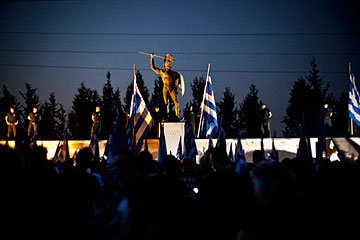
"Blood! Honor! Golden Dawn!" Hundreds of the "new Spartans" rally around a statue of Leonidas, hero of the Battle of Thermopylae.
(2 of 3)
A Greek Phobia
Greece is reclaiming a word it invented: xenophobia. This summer, the government's Public Order Minister Nikos Dendias, from the conservative New Democracy party, ordered a sweep operation called Xenios Zeus — named, without irony, after the god of hospitality. It's now common to see police line up immigrants from South Asia and Africa in public squares and along streets in central Athens. Those without legal-residency permits are arrested and sent to detention centers to be deported. Police claim they have detained nearly 42,000 people since August, though only about 3,400 were arrested for not having residency papers. Dendias defended the crackdown, which was strongly denounced by human-rights groups, by comparing undocumented migrants to the Dorian invaders who purportedly brought down the Mycenaeans in 1100 B.C.
Michaloliakos certainly likes the invasion metaphor. The small, chubby man with Brezhnev eyebrows and a perpetual scowl is a lifelong devotee of the most toxic strain of ultra-nationalism. He was an early supporter of Konstantinos Plevris, a godfather of Greek neofascist politics who's best known for his deeply anti-Semitic book Jews: The Whole Truth, in which he praises Hitler and calls for the extermination of Jews. Michaloliakos also supported the colonels who led the 1967-74 military junta and whom many Greeks despise. As a young man, Michaloliakos was arrested for attacking journalists and carrying guns and explosives; the second offense earned him a year in prison in 1979 and a dishonorable discharge from the army.
In prison he laid the foundation for the movement he would establish in 1985. In its early days, Golden Dawn was so attached to ancient Greek symbolism that its members did not discourage worship of the 12 Olympian gods. (The party now professes to support the Greek Orthodox Church.) By the 1990s, Golden Dawn was attacking leftists and anarchists in an attempt to tap into buried anger about Greece's 1946-49 civil war. By the late 2000s, as more non-white immigrants went to Greece, the party turned on them. As crime increased in central Athens and Greeks grew more fearful of immigrants, the party began to rebrand itself as a patriotic citizen-protection force that would escort old ladies to the bank so they could avoid muggings when they withdrew their pensions. Amid the debt crisis, as austerity measures stalled the country's economy, cutting people's income by up to 50%, the party exploited the ire toward the political elite. Before parliamentary elections this year, Golden Dawn neatly folded the anger about undocumented immigrants and corrupt politicians into one brute slogan: "So we can rid this land of filth."
So far, the Golden Dawn deputies haven't brawled inside Parliament, but they haven't hesitated to take it outside. Ilias Kasidiaris, 31, the party's spokesman, drew international attention in June for slapping a female Communist Party deputy on live TV. More recently, two other parliamentary deputies — Giorgos Germenis, the bassist of a black-metal band, and Costas Barbarousis, a longhaired electrician — were filmed smashing the stands of immigrant vendors in two provincial cities. (Parliament voted to lift their immunity so the two can be charged for the attacks.) Meanwhile, on Oct. 11, Panagiotaros, the Athenian MP, was filmed ranting obscenities during a protest outside a production of Corpus Christi, Terrence McNally's play about a gay Jesus that the Greek Orthodox Church has deemed blasphemous. "Wrap it up, you little f------!" Panagiotaros is heard screaming to theatergoers. "You little whore, your time is up! You f---ing Albanian a------!"
The Secret Formula
The key to golden dawn's rise has been its populism. In late July a small crowd of unemployed Greeks lined up in the main town square in the southern city of Corinth. It was evening, and they were waiting for free packages of rice, pasta, olive oil and potatoes being handed out by 30 burly men in army fatigues and black T-shirts, some with the telltale meandros. Before receiving the food, those in line had to show the men their Greek identity cards to prove their ethnicity. Then they were directed to foldout tables, where more black-clad men, as well as a few women, wrote down names, addresses and ID-card numbers in a membership roster. Anastasia Stergiopoulou, 32, walked away with four bags of free groceries. "The other politicians take things away from me," says Stergiopoulou, who lost her job as a secretary for an agricultural cooperative three years ago. "But Golden Dawn gives me food today, and tomorrow they will find me a job." She proudly says she was one of more than 425,000 Greeks (out of a turnout of 6.2 million) who voted for Golden Dawn in the June 17 parliamentary elections.
Corinth is the main city in Corinthia, a conservative district in the Peloponnese that's anchored by fertile vineyards and a Motor Oil refinery. It also has the highest unemployment rate in the Peloponnese: 17.2%, nearly double the rate at the start of the debt crisis three years ago. Golden Dawn received 10% of the vote there in June, its second best showing in Greece.
The party's MP in Corinth is Stathis Boukouras, 39, a baker who owns a fast-food café. He has roots in Corinthia but grew up in the western Athens suburb of Peristeri. Boukouras is a high school dropout, having left at 16 to run the family bakery in Peristeri after his father was stricken with cancer. As a young voter, he supported PASOK, the center-left party that dominated Greek politics in the past 30 years and whose founder, Harvard-educated economist Andreas Papandreou, connected deeply with a working class that had long been shut out of the political system. But by 1998, Boukouras says he had grown angry at the corruption and lack of "true Hellenic" patriotism in PASOK and New Democracy.
And so in 2000 he voted for Proti Grammi (Front Line), a far-right nationalist party, and a decade later joined Golden Dawn. He admired the party's worship of ancient Greek heroes and its flare-lit marches to stake claims on Imia, the uninhabited islets on a disputed maritime border with Turkey. "I am disgusted with modern Greeks, who have forgotten traditions and don't know who they are," he says. "Ever since I became part of Golden Dawn, I have become a true Greek."