

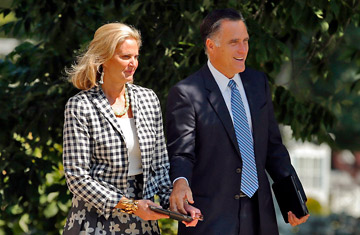
Romney and his wife Ann leave the Church of Jesus Christ of Latter-day Saints near their lake house in Wolfeboro, N.H.
(4 of 6)
Though usually right of center, the Mormon church has staked out different political positions at different times. Utah went for William Jennings Bryan in 1896 and for Franklin D. Roosevelt in all four of his presidential victories. On the conservative side, in the 1950s Ezra Taft Benson served as President Eisenhower's Secretary of Agriculture, ultimately becoming a supporter of the far-right-wing John Birch Society and exploring the possibilities of running on presidential tickets with Strom Thurmond and George Wallace. (Church president David McKay held Benson back.) Among a handful of Mormons, there's also a much disputed report of what is known as "the White Horse Prophecy." Joseph Smith is alleged to have said that an hour would come when the U.S. Constitution would "hang by a thread" and the Mormon people would ride forth to rescue the nation. The prophecy is far from official church doctrine, but it is even now a favorite among radically conservative Mormons. And at the time of Marion Romney's Salt Lake City sermon, Protestant evangelicals, in part in reaction to the Supreme Court's January 1973 ruling in Roe v. Wade, were beginning to organize politically, and Mormons became active in the antiabortion cause.
The story of the church, however, does not march in lockstep with the story of modern conservatism. As Bowman points out, Utah Mormons supported Ronald Reagan by a substantial margin in 1980 only to have the church leadership successfully fight against the siting of MX missiles in the state. "When threatened," said then church president Spencer Kimball, "we become antienemy instead of pro--Kingdom of God. We train a man in the art of war and call him a patriot ... perverting the Savior's teaching, 'Love your enemies.'" As the mood of the country grew more optimistic in the 1990s, the Mormon hierarchy urged the faithful to view the world in less hostile terms. Every election year, the church issues a letter reminding members that "principles compatible with the Gospel can be found in the platforms of various political parties."
A Question of Charity
The voice on the video is steady, the message seemingly stark. "There are 47% of the people who will vote for the President no matter what," Romney said at a private fundraiser in Boca Raton, Fla., in a May recording reported in September by Mother Jones magazine. "All right, there are 47% who are with him, who are dependent upon government, who believe that they are victims, who believe the government has a responsibility to care for them, who believe that they are entitled to health care, to food, to housing, to you name it." He added, "I'll never convince them they should take personal responsibility and care for their lives."
Romney has also clearly articulated the opposite view. "If we're going to help lift our brothers and sisters out of poverty, we must restore our economy and reduce the debt," he told faith leaders in September, in a contrast reported by Christianity Today. "When our economy is healthy and growing, we have the resources to take care of those who still find themselves in need." Moreover, Romney said, "Our government rightfully provides a safety net for the hungry, the homeless, the sick and the elderly, and we have the responsibility to keep it intact for future generations."