

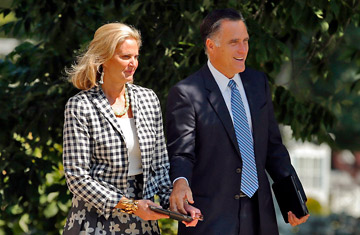
Romney and his wife Ann leave the Church of Jesus Christ of Latter-day Saints near their lake house in Wolfeboro, N.H.
(3 of 6)
Under pressure from locals who were unhappy to have members of the new sect in their midst voting as a bloc and practicing economic communalism, the Mormons soon heard a prophecy from Smith that exalted religious liberty--a liberty the Mormons desperately needed America to protect and nurture. Smith said God had told him the U.S. Constitution was divinely inspired and that the Founding Fathers were "wise men whom I raised up unto this very purpose."
Eventually driven from Missouri, Smith and his flock attempted to settle permanently in Nauvoo, Ill. Yet a backlash against Smith led to the arrest of the prophet, who was ultimately shot to death by an anti-Mormon mob.
Moving westward, the church grew more pragmatic over time, seeking to make peace with the broader world to preserve freedom for Mormons to live as they wished. Even polygamy, the most notorious of Mormon practices, was linked to practical concerns: the church needed new members. As Romney told 60 Minutes in 2007, referring to his great-grandfather Miles Romney, "They were trying to build a generation out there in the desert, and so he took additional wives as he was told to do."
According to biographers Michael Kranish and Scott Helman in their book The Real Romney, in 1862, after signing federal legislation outlawing polygamy, Abraham Lincoln, consumed with concerns about the Union, told a messenger to "go back and tell Brigham Young that if he will let me alone I will let him alone." Lincoln's "true priority," wrote Kranish and Helman, "was to ensure that Mormons stayed out of the conflict." Which they did. They had their own concerns and did not need to invite a war with the Union.
By the last years of the 19th century, the church had officially abandoned polygamy--not least in order to win statehood for Utah. Theology conformed to political reality; a tenet of the faith gave way to the needs of the moment. The decision on polygamy, announced in 1890, had a particular effect on the Romney family. Mitt's great-grandfather went to northern Mexico and created a Mormon outpost at a time when the faith of the church included plural marriage. A crisis shook the clan when it was driven out of Mexico by revolutionaries. As a boy, George Romney, Mitt's father, was part of this latest Mormon exodus. Circumstances changed, and one had to cope.
Politics and Pragmatism
It is possible that Mitt Romney's tendency to conform to the world immediately around him is at least partly rooted in the history of his family and of his church. In Massachusetts he was a moderate; when seeking the nomination of a more conservative national party, he moved right, often not even trying to explain why he might have held such different opinions in such a relatively short span of time.
Romney's commitments to liberty and individualism as organizing American principles also have Mormon origins. "People from all over the world who prized freedom--the innovators, the pioneers, the dreamers--came to America," Romney wrote in No Apology. "And so they continue today ... It is this love of liberty and the accompanying spirit of invention, creativity, derring-do, and pioneering that have propelled America to become the most powerful nation in the history of the world."