

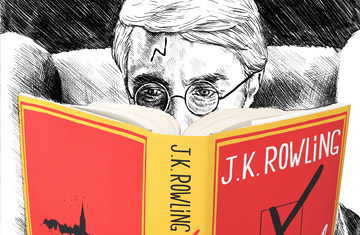
Illustration by Sam Kerr for TIME
(2 of 3)
Jane Austen once advised a young writer that "three or four families in a country village is the very thing to work on." Rowling is on the Austen plan here. The Casual Vacancy is set in a picturesque English town called Pagford. It begins with the sudden death of Barry Fairbrother, a member of the Pagford Parish Council, which is locked in an internal struggle over the Fields, a low-income housing development that borders Pagford's larger, less lapidary neighbor Yarvil. Some Pagfordians, who resent the burden of the Fields, want to rezone it as part of Yarvil, but Barry was sympathetic to the Fields. His death creates an opening on the council--the technical term is a "casual vacancy"--and in their unseemly haste to fill it, Pagfordians on both sides expose their carefully concealed inner lives.
Rowling arranges her characters not in neat opposing ranks but in a complex web. Among the citizens we meet are Colin, a neurotic deputy headmaster (and Fats' adoptive father) who wants to carry on Barry's work; Howard, a deli owner and leader of the anti-Fields lobby; Miles, Howard's son and Barry's former business partner, whom Howard is grooming for the empty spot; and Kay, a social worker who visits families in the Fields, including that of Krystal (she of the splendid breasts), whom Barry coached in rowing. It's in this Gordian tangle--and that's only about a quarter of the full tangle--that one sees most clearly the patient hand that built Harry Potter's world, a universe so detailed that an entire generation has pretty much chosen to live there.
Based on that pitch alone, The Casual Vacancy might seem to be light social satire, a skewering of small-town foibles and hypocrisies. But Rowling has always been more ambitious than that. Her interest is in the emotional and social gaps between us and the grotesque emotional wounds we inflict on those on the other side, always in the belief that we're acting in righteous self-defense. The people of Pagford can't go five minutes without lying to someone else or themselves; the town's psychic currency consists of "things denied, things untold, things hidden and disguised." When they do try to tell the truth, they discover that the tools at hand, words, are pitifully inadequate. (Rowling, by contrast, shows off a new descriptive dexterity: a used condom in the grass is "the gossamer cocoon of some huge grub"; an old woman's fingers are "a clutch of bulging knuckles covered in translucent leopard-spotted skin.")
In Pagford they all believe they're the hero of the story, but as the point of view restlessly shifts, we see each character recast as villain, victim, fool, lover, ally, traitor. The sexually precocious Krystal is a daughter of the Fields, and each side uses her to bludgeon the other: she's a cautionary tale, a model of educability, a bully, a loyal sister keeping her family together. The truth is, she is all those things. (Krystal's mother is a heroin addict, and the story of that shattered tribe is the most wrenching thing in the book.) As the vote over the vacancy approaches, the fight descends into a hail of body blows from which not all the characters will recover. There is no Dumbledore to step in and declare a moral victor.