

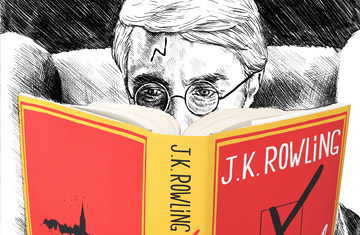
Illustration by Sam Kerr for TIME
I don't think it's especially ungallant of me to have doubted J.K. Rowling. Like a hundred million or so other people, I have a genuine love for Harry Potter, but I wanted to be realistic: a lot of young-adult authors have tried their hands at literary fiction, and unless my literary sabermetrics are off, not a lot of them have succeeded. Not even Roald Dahl could switch-hit.
But when I read Rowling's The Casual Vacancy, I was surprised not only by how good it was but also by the way in which it was good. I suppose I'd expected a kind of aged-up, magicked-down Harry Potter, showcasing the same strengths the Potter books did: Rowling's meticulous plotting, her inventiveness, her love of mischief, her likable characters, her knack for visual spectacle. I also expected it to showcase her weaknesses, because all writers have them. Personally, I think the Potter books have too many adverbs in them and not enough sex.
But The Casual Vacancy (Little, Brown, 503 pages) is a different beast entirely. It's a big, ambitious, brilliant, funny, upsetting and magnificently eloquent novel of contemporary England, rich with literary intelligence and bereft of cant, and if it had been submitted, which I assume it wasn't, it would or at least should have contended for the Booker Prize. It's as if Rowling (like Hogwarts professor Remus Lupin) were a werewolf, except that instead of turning lupine when the moon was full, she turned into Ian McEwan.
Before I get into the plot of The Casual Vacancy, I want to call out one character in particular, a sardonic schoolboy known as Fats, because he's an instructive point of comparison. Having read all 4,198 pages of the Harry Potter series, I thought I'd heard most of what Rowling had to say about the inner workings of teenage boys. I was wrong. Here's Fats skipping school--he wears his uniform "with the disdain of a convict"--and thinking about his life and his obsession with what he calls authenticity:
The mistake 99% of humanity made, as far as Fats could see, was being ashamed of what they were; lying about it, trying to be somebody else. Honesty was Fats' currency, his weapon and defense. It frightened people when you were honest; it shocked them. Other people, Fats had discovered, were mired in embarrassment and pretense, terrified that their truths might leak out, but Fats was attracted by rawness, by everything that was ugly but honest, by the dirty things about which the likes of his father felt humiliated and disgusted. Fats thought a lot about messiahs and pariahs; about men labeled mad or criminal; noble misfits shunned by the sleepy masses.
Fats, like so many adolescents, has grasped a truth and made the mistake of believing it to be the whole truth. He could be talking about Harry Potter in that last sentence (messiah, pariah, noble misfit), but whereas Harry lives a fantasy, Fats must coordinate fantasy and reality, which is a very different task indeed. Long before you get to the "splendid breasts" and "miraculously unguarded vagina" of the girl Fats is meeting later for a callous shag in a graveyard, you know you're not in Hogwarts anymore or even in its affiliated den of sin, Hogsmeade.