

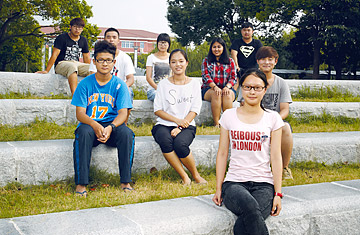
Lin, foreground, is part of the first class of students at Xing Wei, a liberal-arts college in Shanghai
(2 of 2)
More important, Xing Wei's faculty has reinvented the curriculum. Students spend the first two years of the school's four-year program examining issues from several angles. They can study the environment, for example, through biology, philosophy and history. They must then spend two years abroad: one year in a developing country and the other in a rich one. The goal is to educate a generation of leaders who will move China into its next phase of growth. "Independent thinking and the ability to create something becomes more important," Chen says. "We want to prepare students for a society that will be different from what they've experienced over the last 20 years." Lin, for one, plans to study business but is also interested in history, math, literature and design. "The world is multifaceted, and we need wide knowledge," she says. "China can't just do manufacturing anymore. I think China will need creativity."
China's experience with Western-style education dates back to the 19th century, when several well-known liberal-arts colleges were opened, many by missionaries. But their foreign connections and bourgeois image led to their closure after the Communist Party came to power in 1949. The intellectual energy of the nation's youth was then directed toward science to help China increase its military and technological clout. During the Cultural Revolution of 1966 to '76, a period of extreme political violence in which hundreds of thousands died and higher education was largely abandoned, Chairman Mao dryly noted, "We still need universities, and by this I mean science and engineering universities." The economic reforms begun under Deng Xiaoping in the late 1970s continued to stress technical skills above all.
The first sign of change was a 1998 directive from the Ministry of Education that allowed universities to begin small liberal-arts programs on their campuses. Fudan University started Fudan College in 2005, modeling it on Yale's residential colleges. Tsinghua, Nanjing, Peking and Zhongshan universities followed suit, and now more than 50 universities in China are experimenting with a liberal-arts component.
U.S. liberal-arts colleges have also grown more active in China. Representatives of 13 schools, including Williams, Amherst, Swarthmore and Pomona, toured Beijing, Qingdao, Suzhou and Shanghai this summer. Claire Du, who grew up in the central Chinese city of Changsha and graduated from Minnesota's Carleton College in 2008 with a degree in history and international relations, co-founded the tour in 2009 to introduce at home the type of education she received abroad. "Chinese students are dying for a nonconventional, more liberal approach to education," she says.
The full impact of this shift won't be felt until today's liberal-arts graduates from China grow into leaders. It may take years. Science graduates still enjoy better pay and more-prestigious jobs, and they dominate the Chinese government and bureaucracy. Eight of the nine members of the Politburo Standing Committee, the country's top decisionmaking body, have an engineering or science background. Changing higher education alone isn't enough; the gaokao testing system also needs reform so high school students will enter college prepared to think critically, not just memorize test material.
In the meantime, Chinese attitudes toward those who take the less traveled road to a liberal-arts degree are already changing. When a professor at one of China's top research universities called someone a "silly liberal-arts girl" on Sina Weibo, a Chinese Twitter-like service, it set off a flood of more than 5,000 comments, most supporting the student. "Every elite school has this kind of science and engineering professor who only knows his field," wrote Peng Wanrong, an arts professor at Wuhan University, in June. "Put him in the bigger world and he hardly realizes his knowledge is limited as a frog in a well." China's next generation of students have much wider horizons.