

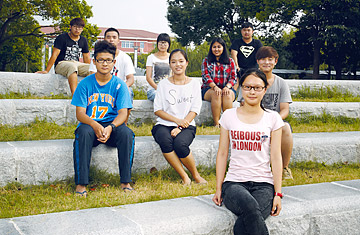
Lin, foreground, is part of the first class of students at Xing Wei, a liberal-arts college in Shanghai
Tina Lin was a model Chinese high school student, with good grades and dreams of attending a top university. Then she hit a wall: the gaokao, the all-important multiday examination that determines where all Chinese students go to college and even what subjects they can study. Lin's score was decent but not high enough for admission to the engineering or science program at an elite university. She struggled over what to do next until stumbling onto a new liberal-arts college, Xing Wei College in Shanghai, at a school fair. Lin joined Xing Wei's first incoming class of 30 students, which includes two Americans, this fall. "In traditional schools, students don't ask questions. They just keep silent," Lin says. "But I like to ask questions. And I want to do something different."
It was not an easy choice. She will be following an unconventional educational path at a tiny, unknown school in a country where even the phrase liberal arts is frowned upon. The direct translation, ziyou jiaoyu, connotes freedom and democracy — sensitive topics in China — so less direct phrases like general education and cultural quality education are used instead. Lin's family, meanwhile, worries that students with specialized engineering or science degrees will be more competitive than Lin in the job market.
While still a small minority of the 23 million Chinese in college, students like Lin are increasingly common. China's economy is making a painful break from its reliance on cheap manufacturing, so students and educators are beginning to wonder whether the old educational model still works. Some question whether the utilitarian bent of China's higher-education system has left its youth without a strong sense of morality, contributing to rampant corruption and fraud. "Highly specialized education often ignores ethical, cultural and moral values," said Lu Fang, vice president of Fudan University in Shanghai, in a speech last year. "Along with a lack of humanity, some students are missing a sense of social responsibility."
These uncertainties are fueling the growth of dozens of new Chinese liberal-arts institutions formed in the mold of elite U.S. colleges. The Chinese government and many educators have realized that traditional professional training is not giving students adequate analytical or problem-solving skills, says Jiang Youguo, an independent scholar who researches higher education at Harvard's Fairbank Center for Chinese Studies. "It's a turning point for China's Education Ministry and universities and educators to start thinking about what kind of citizens they need to cultivate to meet local Chinese needs and global needs."
Xing Wei College is built, almost literally, on the ruins of the old model. Its founder, Chen Weiming, graduated from Harvard Business School in 1993 and was working in finance in Shanghai when his company acquired a technical college that was deeply in debt. "As I started running the college, I started thinking more about what its future would be," Chen says. He noticed the waves of students trying to go overseas — there were 157,558 Chinese students in U.S. colleges last year, accounting for more than one-fifth of international students — but most of them study management or engineering. "Our idea was that China should have its own liberal-arts colleges," Chen says. So he phased out the technical school in 2010 and started Xing Wei on the same campus, shrinking it to a maximum student body of 1,000 from the 10,000 it housed before.