

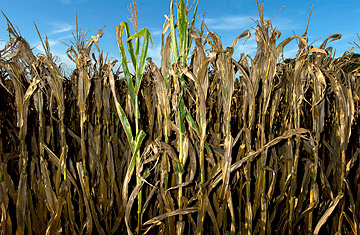
A historic drought has already wilted U.S. corn crops, and the damage has only begun
Meteorologists call drought the "creeping disaster" because, unlike hurricanes and tornadoes, droughts normally unfold in slow motion, day after dry day. The "flash drought" of 2012, though, is proving to be anything but a slow burn. From the middle of June to the middle of July, drought gobbled up cropland at an alarming rate, pushing the amount of land under severe drought from 17% to 39% of the continental U.S. Bone-dry weather combined with high temperatures--2012 is on track to become the hottest year on record--sucked the moisture from the air and the soil, toasting America's breadbasket. More than half the continental U.S. is parched--the largest swath of the country that has been this dry since 1956.
Crops are wilting in Corn Belt states like Illinois and Indiana, where some farmers have already given up on a harvest. Only 26% of the corn crop is currently rated good or excellent, according to the U.S. Department of Agriculture (USDA), whereas 45% is rated as poor or very poor. What was expected to be a record harvest--farmers planted more corn this spring than in any year since 1937--is sure to disappoint; the USDA has already cut the projected corn yield by 12%. That's caused prices to rise, with corn hitting a record $8.24 a bushel on the Chicago commodities exchange. Last year at this time it was less than $7 a bushel.
The torrid weather is hitting at a time when grain stockpiles are unusually low, increasing pressure on prices. If the drought lingers--and weather forecasts offer neither rain nor hope--we can expect to see more-costly food across the board this fall in the U.S. and, even worse, in developing nations where hundreds of millions already go hungry.
We've seen this before. Sharp spikes in the price of food in 2007 and 2010 helped lead to riots and may have been one of the sparks for the Arab Spring. It's no wonder that USDA Secretary Tom Vilsack's drought response apparently includes appeals to a higher weatherman. "I get on my knees every day," Vilsack told reporters in Washington recently. "If I had a rain prayer or a rain dance I could do, I would do it."
The secretary's rain dance is most needed in the heart of America's Corn Belt, where the drought is reviving memories of the Dust Bowl in the 1930s. But while farmers are the first victims of drought, a lot has changed since dispossessed Okies fled parched Midwestern farms for California during the Great Depression. For one thing, today's farmers had been doing pretty well: high crop prices, fed in part by growing incomes in overseas markets like China and by mandates for corn ethanol, helped U.S. farm income reach a record $98.1 billion last year. Farmland in the Midwest was going for some 10 times as much per acre at the start of the 2012 growing season as it was a decade ago. There are fewer farmers now--just 1.2 million in the U.S., compared with 6.8 million in 1935--but they tend to be better off than the average American. While the financial hit from the drought of 2012 will almost certainly eclipse the $78 billion in inflation-adjusted losses recorded during the great drought of 1988, the agricultural sector is in much better shape to absorb the damage.