

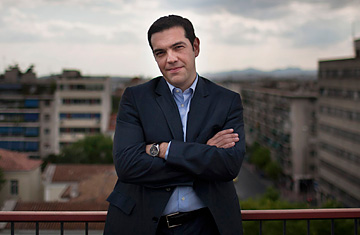
Greek Politician Alexis Tsipras, on the rooftop of Syriza Party Headquarters.
(2 of 2)
Many in the country and the rest of Europe worry that Tsipras and Syriza — which is an acronym meaning the coalition of the radical left — don't have the experience, skills or flexibility to come up with a realistic plan to keep Greece solvent and in the euro. "He is young and clever and he has a leader's self-assurance," wrote Nikos Konstandaras, an editor at the Greek daily Kathimerini, in a recent essay. "Unfortunately, he also has the same great weakness of most of his predecessors in Greek politics — instead of formulating policies to deal with pressing problems, he is happy to flatter a nation which has its own fatal weaknesses for flattery and lies."
An activist since joining the Communist Youth of Greece as a teenager, Tsipras led student occupations of schools in the early 1990s to oppose education privatization. He has been a public figure ever since. Many Greeks remember him as the confident high schooler with the Johnny Depp hair who was interviewed on national television. "The guy is consistent. He doesn't change his views and doesn't change his values in his personal and political life," says Mathaios Tsimitakis, who met Tsipras during the student occupations and has remained friends with him. Tsimitakis says Tsipras is devoted to his longtime partner Betty, whom he met in high school, and their 2-year-old son.
Nevertheless, as his star has risen since the May 6 election, Tsipras has also softened his politics. He has said he would give up being Prime Minister if it would pave the way for a coalition government that didn't include pro-bailout parties. While he still challenges Merkel and the euro-zone leaders in Brussels to change their policies toward Greece, he also says he's not going to walk away from negotiations. And though he still invokes leftist ideals, he sounds more like a moderate (or a center-leftist) when addressing issues like tax evasion and corruption. He says he agrees that Greece must make tough structural reforms. He proposes cracking down on corruption and tax evasion, especially by the rich. He wants to create an assets registry with which Greeks could register property and bank accounts so all can be taxed fairly. Says Tsipras: "We need to fight corruption in order to convince Greeks to contribute to this effort."
The powerful in France and Germany, however, have steered clear of Tsipras. Merkel ignores him and continues to say that Greece must stick to loan agreements to keep getting aid. Still, Tsipras says he abhors depictions in the Greek tabloid press of her and other Germans as Nazis. "It's unfair, and this course must absolutely be reversed," he says. "But the reversal of these attitudes must be driven by mutual initiatives. German leaders must understand that they should not insist on the same hard fiscal proposals, and more importantly, they should not insult the dignity of the Greek people. Greece is a sovereign country, not a German colony."
He believes the E.U. must now make hard and critical decisions. "Europe is at a crossroads, the same crossroads it was at in the 1930s during the aftermath of the economic crisis of 1929," he says. "The U.S. followed the New Deal policy by Franklin Roosevelt. Europe, on the other hand, chose policies of fiscal discipline that eventually led to the rise of national socialism and Nazism in the heart of Europe, Germany. Today, Europe is again at a crossroads. I don't want to be a Cassandra, but either we will become wiser from our past experience — we will realize that Roosevelt was right and follow that path — or Ms. Merkel will insist on her policies, which lead to a dead end. She will bear heavy responsibility for bringing down the euro zone and European Union."
So what if Syriza comes to power and Europe doesn't go along with Tsipras' ideas? Does he have an option for a worst-case scenario? "Indeed, we have a plan," he says. "There's a team of economists who lay out the plans, update and communicate them. I am not superstitious, but I don't really want to talk about it. I don't think it would be useful, since it would be a signal that we're leaning toward the worst-case scenario. That's the last thing we want."