

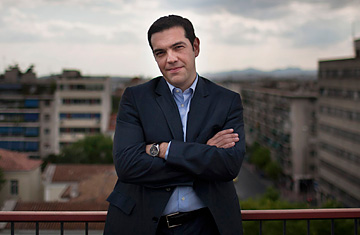
Greek Politician Alexis Tsipras, on the rooftop of Syriza Party Headquarters.
A framed photograph of Che Guevara exhaling a cloud of cigar smoke hangs in Alexis Tsipras' modest office in central Athens. It's an easy symbol for those in Europe who see the leftist Greek politician as a dangerous ideologue threatening to drag his country out of the euro and bring drachmageddon not only to Greece but to the European Union. The demonization bemuses Tsipras, 37, a calm civil engineer who says he's merely a realist. "Greece has been a European and international experiment, and the Greek people have been the guinea pigs," Tsipras tells TIME. "In the past two years, we have suffered a social catastrophe. One out of two young Greeks are not only unemployed; they cannot even dream or hope for a better future. The country doesn't export olive oil, oranges, cheese and olives anymore. It exports young scientists. It's a bleeding that has to stop."
Tsipras was an obscure opposition politician just weeks ago, but now he's unnerving the powers that be in the E.U. That is because he and his Syriza party may just win enough seats in Parliament on June 17 to form a government, alone or in coalition. A first round of voting on May 6 led to a stalemate, with no party — not even the two mainstream ones — able to form a coalition. But the surprise was Syriza, which came in with the second most seats, more than tripling its share of the vote from 2009. The win was a blow not only to the ossified political class but also to the austerity politics it had acceded to, which were imposed on the debt-ridden country by the E.U. — or, as many Greeks see it, by Germany and its Chancellor, Angela Merkel. As a Syriza slogan declared, "They decided without us. We'll go on without them."
Tsipras had held to his principles for two years, ever since the E.U. first bailed out Greece in 2010. But Greeks didn't buy his message until the May vote. By that time, the country had about lost patience with the tax hikes and wage and pension cuts forced on it as conditions for the infusion of funds Athens needed to satisfy its creditors. Greeks were then infuriated to hear from international lenders that they weren't doing enough to get themselves out of their fiscal hole. Protests grew and did not end. The PASOK government of Premier George Papandreou, the heir of a storied political family, resigned. A coalition government led by an experienced central banker, Lucas Papademos — E.U.-approved — couldn't calm the country.
Amid the turmoil, Tsipras executed a dramatic and canny political metamorphosis, transforming himself from the leader of a radical leftist coalition to a left-of-center standard bearer for anti-bailout and anti-austerity populism. "It's a paradox to think Greece can stay in the euro zone if the austerity policies continue to be implemented," he says. "These policies were the wrong medicine for the crisis. When there is a patient and you give him medicine and it only makes him worse, it is not logical to insist on giving him a higher dose of the same medicine. You've got to change the medicine. If we continue taking this austerity medicine — and especially at a higher dose — that's when Greece is going to be forced out of the euro. And when Greece leaves, the whole euro zone will start wobbling." Indeed, a Greek exit could begin a domino exodus of such troubled economies as Spain, Portugal, Ireland and even Italy, effectively wrecking the historic enterprise of the E.U.
That Greece's weakness can be wielded as a threat has resonance among Tsipras' fellow citizens, and he has benefited from the electoral calculus. Polls show Syriza — a leftist collection ranging from ultra-communist to moderate — and the conservative New Democracy party, which supported the second bailout, running close. If his party manages to win on June 17, Tsipras says he is not going to back down on his rejection of the harshest terms of the billions in bailout loans that are now keeping Greece solvent. "This agreement died on May 6," he says, referring to the fact that more than half of Greek voters chose anti-bailout parties. And even though New Democracy leader Antonis Samaras says Tsipras' anti-bailout stance will push Greece out of the euro zone, Samaras is taking a cue from the younger man's playbook and quieting his pro-bailout talk.
The June 17 election, Tsipras predicts, "will be a contest between the forces of yesterday's compromised politicians and the fear they peddle and the forces of hope and building something new." He says he will not form a coalition with New Democracy or PASOK, which has run Greece for 21 of the past 30 years. "You can't build something new out of old, worn-out materials," he says. "I predict that there won't be a third election. The polarization is so clear that either one party will win or another. All the cards are laid out on the table."
And yet Tsipras is playing the game shrewdly. Even as he says that the status quo on austerity is untenable, he reiterates his country's commitment to the euro. He says his party doesn't want it both ways: in the euro but without the obligations of paying back debt. "It's not our choice for Greece to exit the euro zone, and it's not an option," he tells TIME. "Greece's fate is linked to Europe's and vice versa." Again and again, Tsipras insists he is not trying to blow up the euro and Europe. "Europe," he says, "has a special role globally as a stable and secure power between the U.S. and rising superpowers. I believe it would be a tragedy if the euro, the second biggest reserve currency in the world, collapsed."
But, he says, "we want our European partners to accept what is fair for Greece and adopt a plan for fair fiscal reforms and economic and social growth. It may take time, but we need to avoid more pauperization of this country." Indeed, a return to the drachma — while recommended by some economists — could see Greeks losing as much as two-thirds of the value of their savings and other assets. Tsipras says he's not selling a no-pain pipe dream to get elected. "We've never said the path we propose will be strewn with rose petals," he says. "It's going to be a difficult one, mainly because at this point, Greece is no longer on the brink. It's fallen off the cliff."