

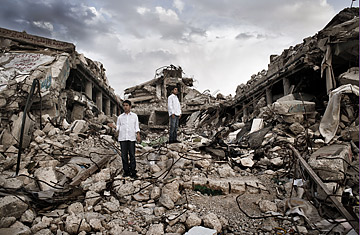
Haroun Milad and his brother Moussa amid the wreckage of Gaddafis museum in Tripoli
(3 of 3)
Salem al-Ferjani, who was formerly with the transitional government but now works for a Tripoli NGO, says incorporating fighters into a national army and police is a great plan but it's not for everyone. "You have to open other channels for them," he says. "Not all the rebels want to become soldiers." He explains: "Before they used to call themselves rebels. Now they call themselves militias. But if you go back to the 17th of February [when the uprising began in 2011] and you consider who they are — doctors, engineers, students and the unemployed — they were people who found themselves in a situation in which they had to fight ... These people need rehabilitation." The government, he says, has dealt with the ex-rebels by throwing money at them. "I'm not against giving money — they deserve it. But far more important is that they're just carrying their guns and they don't know what to do. The war is finished and they're still unemployed. They want to know what the future is. All they need — those militias — is someone to take care of them."
Safeguarding Libya
Libya's coming exercises in democracy — a parliamentary election in June, a constitutional convention soon after — are crucial to setting up the framework for its future. A lot can go wrong. People with guns, unhappy with the results, may once again take matters into their own hands. At various points in the past six months, they have, in some cases sparking tribal clashes that have lasted for days. The federalists in the oil-rich east may also choose to not be so patient. Most Libyans are cognizant of the enormous tasks ahead — and remain almost surreally optimistic. The bitterness left by war, says al-Ferjani, is not insurmountable. The key is reconciliation, he says, and getting the country's fledgling justice system on track. "If you think about reconciliation without truth and justice, it's impossible to accomplish," he says. Fair trials for prisoners from the Gaddafi era, al-Ferjani argues, may also facilitate the dismantling of the militias. "This is one of the reasons why people in Misratah, Zintan and Tripoli are still afraid. They are afraid that the Gaddafi loyalists will come to power again or that no one will send them to court."
Many Libyans, too, are willing to be patient with the electoral process. "We would be idealists if we expected the first election to be perfect," says Nasser Ahdash, the leader of a pan-Arab nationalist party, the National Libyan Forum. "Even the second and third elections might not be perfect. But we have to review our faults after the first election and we have to work on them."
If democracy is a work in progress, so is Libya's media. But local journalists have learned quickly to thrive in the free-for-all of a free press. "We have TV channels now that criticize the highest authority in this country — in fact, they're criticizing everybody. So this is positive," says Ahdash. "And I think people are learning. This learning is a process that must take its natural course."
Even in Sirt, there is some optimism. Walid al-Zayni, 27, supported Gaddafi "100%" and lost his home, his business and a brother. But he sees a way forward. He says that if the government wants "Sirt to support the revolution, then they need to deal with the people's problems — not by words but by action." In some areas of his town, as in others in Libya, residents have started rebuilding on their own. It's personal savings, they say, not government money. But it's a start. The street corners of Sirt are already lined with Egyptian day laborers, who apparently are finding the relative hopelessness of Gaddafi's hometown still more promising than the postrevolutionary landscape of their own country.
In the capital, Tripoli, stands the unrecognizable wreckage of a Gaddafi museum, which the dictator used to thumb his nose at the U.S. Built around the damage caused by an American air strike in 1986, the museum became a backdrop for Gaddafi's long-winded speeches. It famously displayed a sculpture of a fist crushing a U.S. plane. (Rebels from Misratah eventually hauled it away as a trophy.) On the day I visited, a 12-year-old named Haroun Milad leaned out of the window of his father's car to ask me, "Did you ever expect to see this?" Haroun, his brother and father had just come from a wedding and were visiting the place for the first time. His father Ibrahim says proudly, "I think it's worth saying loudly that when this Arab Spring happened, it spread from the edges — from Egypt and Tunisia first. But Libya has everything it needs to recover itself, to become a superpower."
He remembers the night in March 2011 when NATO first bombed targets in Tripoli. It happened to be close to their house. "And I told them all in the morning that we were going to survive," he says as Haroun and his brother Moussa scramble over the museum's wreckage like a jungle gym. "Now there may [be] weapons in every hand, but we're living securely," says Ibrahim. "That just shows you that Libya has a better chance than any other country. And I'm very confident that Libya will establish a new level of human rights, of economic distribution." The country has only 6 million people spread over a territory bigger than France, Spain and Germany combined; its population is also relatively homogeneous. "It's a unique situation: a big country with a small population and great resources — and it has all been wasted for four decades."
When the kids return, he asks them what their contribution to Libya is going to be. "Every human being is a tree, and when he's small he has to gather more knowledge in order to grow up," Haroun says. His father beams. "I'm not naive," he says, turning to me, squinting against the bright sunshine. "I know we have a huge challenge ahead. But I think we're going to make it."