

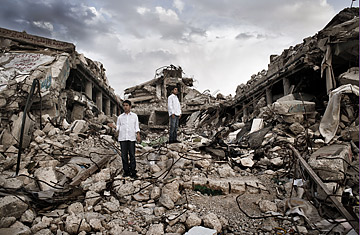
Haroun Milad and his brother Moussa amid the wreckage of Gaddafis museum in Tripoli
(2 of 3)
The Wounds of War
Working together is one thing. But the wounds of the civil war are still fresh and may take generations to heal. Gaddafi's hometown of Sirt in central Libya has been the biggest loser. There, the ground is still littered with shrapnel and bloodied clothing. Houses and schools have had their walls smashed in by rockets and tank shells. Electric poles have been uprooted like trees after a hurricane. At a new children's center run by a local NGO, one child has used crayons to illustrate NATO planes dropping bombs on his town — his terrifying remembrance of the Western intervention that saved the rebellion but doomed the regime. Another has sketched Gaddafi's old green flag with a check mark and the new Libyan flag crossed out.
"How can people come back to this?" asks Ahmed Bushnaf, an electrician, sitting on the curb outside his damaged home in Sirt. "I think it's going to go from bad to worse. There's no security. There are weapons everywhere. I think the families of the tribe will be marginalized." Indeed, for the people of Sirt, who hail mostly from Gaddafi's tribe — the Gaddadfa — not all's well that ends well. Many worry that the name that once ensured them of the best connections may now shut them out from power in the new Libya. "I'm carrying a lot of anger in my heart," says a petroleum engineer who gives his name only as Jumaa. Most of his neighbors have fled the town — or even the country — and have yet to return. "Before, I would have died for my country. But I have no nationalism now."
To Sirt's east, the city of Misratah tells stories from the opposite perspective. The last time I saw Mohamed al-Shami in October, he wore fatigues, shouldered a Kalashnikov and commanded a rebel brigade that, along with other fighters, had broken Gaddafi's months-long siege on Misratah and had pushed on to help liberate Tripoli. Al-Shami has now traded his fatigues for a suit, and he's driving a brand-new white BMW. Misratah, so recently the symbol of Gaddafi's brutality and rebel fortitude, has gone from bombed-out to boom town. BURGER KING, COMING SOON TO TRIPOLI STREET, reads a colorful billboard on Misratah's main drag. (It is a counterfeit of the American fast-food chain.) Many locals lost their lives on Tripoli Street, but now it is full of florists, restaurants and grocery stores. Young men joyride on motorcycles up and down the avenue, past uniformed traffic cops. Everywhere, buildings are under construction.
But even in victorious Misratah, there is bitterness. Nassima Abdul Halim lost her son Mahmoud to a regime sniper the day before NATO intervened in March 2011. As the fighting raged in Misratah, rebels gave her a chance for revenge. They brought her a regime soldier they had captured. They also handed her a gun. "He gave me his back," she recalls. And then she killed him. "The people who were fighting us — we shouldn't be merciful with them because they had no mercy for us. Other mothers did the same," she says, her eyes filling with tears. But she still finds it hard to move on. "We are psychologically destroyed," she says. "We need doctors to help us cope with this suffering."
The Power of the Militias
In the western mountains is the town of Zintan, formerly a poor village of seasonal farmers and shepherds. But now it is one of the biggest victors of the revolution. Zintan has one of the largest arsenals in western Libya — its insurance policy against a return of Gaddafi loyalists or anyone it deems too much like the late dictator. On the day we visited, the town had — simply standing idle and undeployed — 50 tanks, a dozen armored personnel carriers, powerful machine guns and shipping containers full of bullets, mines and rockets, including shoulder-launched surface-to-air missiles that can take down an airplane. They also hold, as another trump card, Gaddafi's son Saif al-Islam. He was captured by Zintani militia in the chaos of the regime's collapse and is held in a secret location in spite of pressure on Tripoli from the International Criminal Court in the Hague to hand him over for trial.
Zintani fighters are all over Libya, patrolling the country's southern and western borders, securing oil fields, intervening in tribal conflicts. At one point, the Zintanis even controlled Tripoli's international airport. While it has given up the airport, Zintan has shown very little interest in surrendering its newfound muscle. "We were the first to carry weapons, and we will be the last to give them up," says Ali Youssef, a spokesman for the Zintan local council. "Zintanis are involved in security for all the tribes in Libya. What would happen if we gave up our weapons now? There's potential for a civil war to explode." It is not just Zintan. There are militias as well operating out of Misratah, Benghazi and practically every city and town that joined the revolution.
The transitional government is now in the process of trying to absorb former rebels into a new national army and police force, perhaps including veteran officers from the old regime. But the revolution has created a new paradigm for those who hold the guns in the new Libya. "A rebel who fought on the front lines is, for us, better than any colonel or general from the old regime," says Ismail Mohamed al-Salabi, a young former rebel, in Benghazi. "We're supporting the real fighters — the revolutionaries — those who fought for the liberation of the country without any orders from the top."