

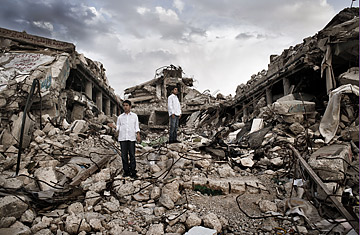
Haroun Milad and his brother Moussa amid the wreckage of Gaddafis museum in Tripoli
(2 of 4)
But in the months since Gaddafi's fall, the residents of the Green Mountains are shifting blame. The dead dictator cannot be held entirely responsible for the problems of the living. Impatient for a reinvestment of what they feel are the profits of their oil riches, eastern Libyans are now criticizing the transitional authorities in Tripoli and calling for a federal system that splits the country into semiautonomous states. It is an idea that has some people--both supporters and opponents of federalism--warning of violence if those on either side of the argument get too pushy.
Oil is the basis of eastern Libya's wanting its fair share of the national wealth. And that promise keeps gushing. Libya has been quite successful in rehabilitating its vast network of oil fields and refineries in the wake of the civil war. The town of Ras Lanuf, one of the country's most important refinery and export points, sits on what was one of the most lethal front lines. The infrastructure changed hands at least six times. But when we stopped there on our way across the country, the oil workers were proud that in a matter of months, they had already improved functionality from 0% to 80%. Some fought on opposite sides of the war, but most deemed oil too important to neglect after the battles were over. "I'm really surprised by how calm and friendly people became after the revolution," says Hasan Murtaza, a Turkish engineer at the Harouge Oil Operations export terminal. "Can you imagine being in a civil war, with both sides losing lives, and now they're coming together and working together? There isn't any tension at all."
At least on the surface, everyone is trying to keep the debate civil. Even federalists like Esbak insist that despite their desire to win more autonomy, they have no intention of monopolizing oil the way Gaddafi did. "Oil is national income, and it belongs to all Libyans and the central government," says Ahmed Zubeir al-Senussi, leader of the federalist cause. "If you're talking about selling, that's for the country to decide." Senussi, however, says eastern Libya may still establish a local militia to "protect" its oil.
A Nation of City-States
Practically every city that joined the revolution created a militia to fight Gaddafi, and after the dictator's fall, none gave up the newfound might. The most extraordinary example is the town of Zintan in the western Nafusa Mountains. Formerly a poor village of seasonal farmers and shepherds, it is one of the biggest victors of the revolution and, having taken much of the regime's arms, has one of the largest arsenals in western Libya. The weapons are its insurance policy against a return of Gaddafi loyalists or anyone it deems too much like the late dictator. On the day we visited, the town had--undeployed--50 tanks, a dozen armored personnel carriers, powerful machine guns and shipping containers full of bullets, mines and rockets, including shoulder-launched surface-to-air missiles that can take down an airplane. They also hold, as another trump card, Gaddafi's son Saif al-Islam. He was captured by Zintani militiamen in the chaos of the regime's collapse and is held in a secret location in spite of pressure on Tripoli from the International Criminal Court in the Hague to hand him over for trial.