

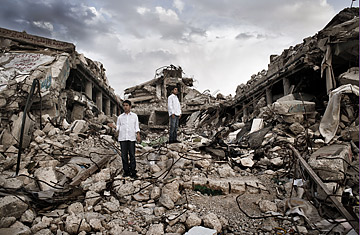
Haroun Milad and his brother Moussa amid the wreckage of Gaddafis museum in Tripoli
The fortress was once believed to be impregnable. But the walls of Bab al-Aziziyah and almost all its buildings have been pulverized into a wasteland. It is as if Libya poured 42 years of rage into the 2.3-sq.-mi. space. All that remain are mounds of ruin, twisted metal and smashed concrete. Some areas have become garbage dumps; others, pasture for sheep. And in place of its old master--the equally pulverized and deceased Muammar Gaddafi--there are new residents, squatters who have moved in to claim Bab al-Aziziyah for themselves. Khadija Mohamed is one of them. She was born the year Gaddafi came to power, and even in the messy months after his fall and death, she is still incredulous at the revolution's achievements. "We can speak," she says. "We can express our ideas. Before, we couldn't even say we were suffering."
The Libyan revolution was the most thorough to take place during last year's Arab Spring--and perhaps in all modern Arab history. And the Libyans are still proud and giddy. "Nothing has changed in Egypt, where the military stayed in charge," says Saad Abdel Ghader, a resident of Benghazi, the birthplace of the rebellion against Gaddafi. "Here we got rid of everything!" But that means Libya must more or less rebuild from scratch. The country--with no experience of democracy--is hurtling toward a national election in June. Meanwhile, regional militias continue to sit on huge caches of weapons, the tribes talk divisively of federalism, and everyone worries about how Libya's enormous petroleum and gas resources are going to be shared. On a 1,000-mile trip retracing TIME's coverage of the revolution, photographer Yuri Kozyrev and I found an almost surreal optimism across the country of 6 million people spread out over territory bigger than France, Spain and Germany combined. The hope is uncanny because Libya faces three grave challenges: veritable city-states that are willing to defend their newfound influence with arms; emotions still raw and unforgiving from the months of conflict; and economic forces that may yet rip Libya asunder. Is hope going to be enough?
Oil: A Double-Edged Sword
Hamad Esbak sees potential. In his hometown of Shahhat, ancient Greek and Roman columns, temples and amphitheaters seem to sprout from the hills almost as ubiquitously as the trees--picturesque vistas just waiting for tourists to explore them. "Look at this--all open space. If we had good people with money in charge, we would build this into something better than Lebanon or Dubai." Esbak's paradise lies in the Green Mountains of eastern Libya. Like most of his neighbors, the property owner took up a gun last year to fight the Gaddafi regime, mostly because the dictator did nothing for the region, letting it rot with malignant neglect despite the fact that it holds some 80% of the country's proven oil reserves.