

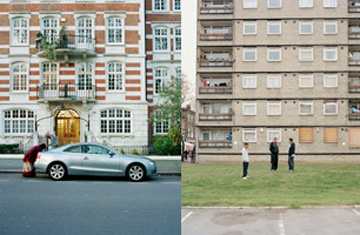
Have and have not London ranks as one of the most unequal cities in the developed world
(2 of 2)
The Debt Drag
Until the 2008 crisis, debt helped disguise widening inequalities in British society. The Tories, followed by New Labour, enthusiastically pushed consumer spending as a goal. "We were all encouraged to spend, because status was so defined by what consumer goods we got," notes Owen Jones, author of Chavs: The Demonization of the Working Class. "That was easy for the middle classes, but that pressure on working-class people made them rely on cheap credit." Booming financial markets and easy credit exacerbated inequality, according to a recent paper by International Monetary Fund economist Michael Kumhof. His research found that external debt in Britain and the U.S., measured by the countries' current account balances, rose 1% to 2% for every percentage-point rise in the income share of the top 5% of earners from 1980 to 2007. Government coffers, swollen from a booming economy increasingly based on finance, allowed Labour governments to go on the biggest spending spree in Europe, creating nearly 850,000 public-sector jobs, tripling spending on the National Health Service and awarding tax credits to parents and low-income workers.
At its postcrisis peak, Britain's public deficit nudged 12% of GDP, among the highest in developed countries. Over the next three years, the government will have cut nearly a half-million of the nation's 6 million public-sector jobs, all while raising taxes and scaling back on housing and unemployment benefits. "In the last decade or so, low and middle incomes have been propped up by nonearnings," notes Matthew Whitaker, the Resolution Foundation's chief economist. "Now all these props are being pulled away. This not only has social implications but implications for the British economy, where growth has been built in recent years on consumption. It's not going to be there anymore."
Of course, people in neighborhoods like St. John's Wood are still spending. "If anything, we've found that the recession has only supported and upheld the luxury, high-wealth industry. In times like these, people are more keen than ever to invest in something tangible — be it property, art, jewelry or even wine. They see a value and even a comfort in paying for something of worth," says Emma Johnson, editor of Vantage, a magazine for affluent northwest Londoners. Last year Britain's luxury-goods sector grew by 8%, thanks in part to big spenders from the U.S., Russia and the Middle East flocking to London. Luxury department store Selfridges reported a 40% rise in sales to foreign customers.
Frustration Nation
Recent outrage over growing income disparities hasn't gone unnoticed by the British establishment. In January, sensing the public mood, the government stripped Sir Fred Goodwin — a former head of the Royal Bank of Scotland, whose collapse in 2008 prompted a $74 billion bailout — of his knighthood. In 2009 the chairman of the Financial Services Authority, Adair Turner, asserted that the 2008 crisis showed that parts of the sector had grown "beyond a socially reasonable size." Two years later, he suggested in a public lecture that most innovation in the banking sector has added little to economic growth and that either state intervention or taxes on financial activities were a potential way of curbing banks' attempts to extract "rent."
Prime Minister David Cameron chimed in this fall, telling the Confederation of British Industry (CBI), "Everyone agrees now that in the past, Britain's economy had become lopsided — too dependent on debt, consumption and financial services." Cue his list of investments in ports and electricity markets and details of government wooing of foreign manufacturing giants like Siemens. In late December, CBI director general John Cridland called for a "rebalancing of the British economy," moving away from debt-driven consumer-spending growth toward business investment and net trade. "The emerging middle classes of Latin America and Asia want British-branded consumer goods and services, but to do that, we're going to have to start investing in selling to the markets of the world where currently we're underrepresented — the emerging and developing economies."
Shifting Britain's economy away from finance won't come easily or fast. When Tony Blair's Labour government was elected in 1997, manufacturing was over a fifth of the economy; by 2007, that figure was 12%. While the City's share of the economy has grown since 2005, now standing at about 10%, manufacturing lost over twice the proportion of jobs as finance and business services in the first year of the financial crisis. This only exacerbates what Jones says has become an "hourglass" economy, with many top jobs in hedge funds and law and dead-end jobs at call centers and supermarkets on offer but very little in between. "For decades, we had an economic policy tailored to the interests of the City," notes Jones. "High interest rates, a strong pound — all benefited the financial-services sector, but they were extremely damaging when it came to manufacturing jobs, which were never replaced."
For Britons like Cable, reliant on public-sector health and education services as well as housing and unemployment benefits, far worse is to come, and frustration is rising. The Institute for Fiscal Studies noted earlier this year that just 12% of the planned cuts would have occurred by now. "There's a new awareness of class, not just of the people at the top — the bankers, who are being blamed for all of this — but on the other end of the spectrum, of the divisions between the deserving and the undeserving poor," says Will Atkinson, a sociologist at the University of Bristol.
In March an independent-panel report on the 2011 London riots said youth need jobs and opportunities — "a stake in society" — if Britain is to avoid more unrest. For now, the tensions between the top and bottom ends of society show up in small ways, like a recent altercation over a parking space on St. John's Wood High Street. A carefully streaked blonde in fur emerged from her Range Rover to fend off a hollow-eyed, screaming woman standing beside her battered Toyota to defend her right to the spot. The Toyota driver's anger was loud enough to draw a crowd: "She's calling me pikey," yelled the woman after the two exchanged heated words. "Did you hear that?" she cried about the slang reference to someone of low social class. Nobody answered.